For a while now, I’ve had a genuine fascination with the work of Ben Lerner. I first encountered his writing in a contemporary fiction class during my undergraduate degree. I opened his 2014 novel 10:04 and didn’t close it again for six hours, reading it cover to cover in one sitting. There was something hypnotic about it—an author who seemed to have his finger on the pulse of an anxiously empathetic society.
A year later, I wrote my dissertation, “A profound experience of the absence of profundity: Ben Lerner and the Aesthetics of the Anthropocene.” In it, I explored whether the novel can still function as a meaningful art form in an era defined by ecological crisis and societal fragmentation. I believe it remains a vital aesthetic medium, capable of evolving in form and voice to bridge individual and collective experience.
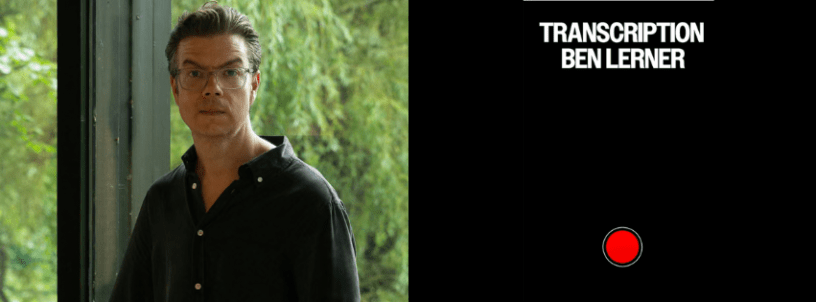
All of this made April 16th, 2026 feel quietly significant. Lerner appeared in Edinburgh for a Toppings & Company Booksellers event promoting his latest novel, Transcription. In it, a writer returns to interview his mentor, only to break his recording device setting off a meditation on technology, inheritance, and the strange power of the disembodied voice.
I booked tickets early, dragged a friend along, and brought my battered copy of 10:04 with hopes of getting both books signed. The talk itself was thoughtful, layered, and deeply in tune with the concerns that have long drawn me to his work. Lerner described his belief that,
“Fiction is the capacity to move between realities” in order to seek “a kind of collective dreaming protocol”.
Ben Lerner (2026)
Regarding the relevance of contemporary writing, Lerner sees the world as “unordered, [so] reality and fiction is the way we order it into configurations”, therefore, “the closer something is to reality, the more intense that imaginative re-description feels”.
Listening to him, I was reminded why his work resonates so deeply. He doesn’t just write about contemporary life; he interrogates the structures that make experience legible in the first place.
And yet, hovering over all this was an anticipation: the book signing. Anyone who’s attended one of these events knows the peculiar mix of excitement and awkwardness it brings. I had stationed myself strategically near the front, hoping to avoid a long queue, rehearsing some version of what I might say.
But as the talk concluded, the announcement came: Lerner had to leave immediately to catch a flight.
Just like that, he was gone.
The anticipation dissolved almost instantly, replaced by something stranger—not quite disappointment, not quite relief. It felt, in an odd way, entirely appropriate. Almost like stepping into one of his novels, where expectation and deferral coexist. It reminded me of the hurricane that never arrives in 10:04: the event you brace for that transforms into its own absence.
Was I understanding? Of course. Was I disappointed? Also, yes.
But maybe that’s the question underlying all of this: should we meet our heroes? Or is there something more fitting—more Lerner-esque—about remaining at a distance, where meaning continues to flicker between presence and absence?
As with most minor devastations, my friend and I turned to each other, paused for a moment, and said the only reasonable thing:
“Pub?”
By Lucy Horton
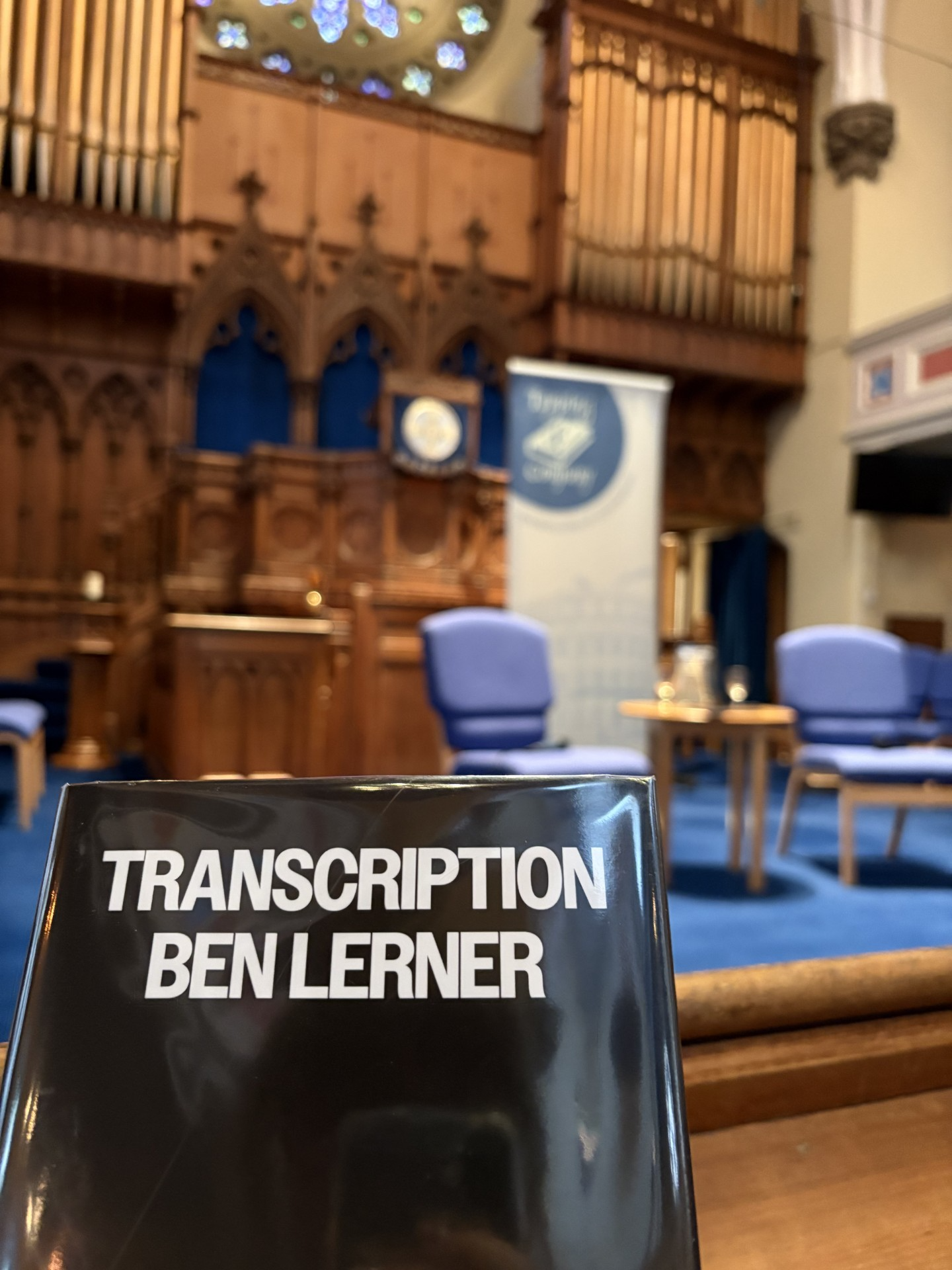
Lerner, B. (2026) ‘Ben Lerner for Transcription’, [Book talk], Pilrig St Paul’s, Edinburgh, 16 April.

