
Wandering up the cobbled road off Broughton Street, I found myself approaching The Outhouse – current home to the Edinburgh Literary Salon – with an intrigue as to what a literary salon was actually going to discuss. From their own website, this month’s discussion was to be about welcoming us students, discussing independent bookshops, and promoting the many book-themed festivals in and around Edinburgh (Edinburgh Literary Salon).
My friends and I arrived just on time to squeeze ourselves into the back of the upstairs event space, nicely positioned by the bar and with a wide view of the makeshift stage in front. The entire left side of the room was overrun by Napier students which was swiftly pointed out by the organisers, but I was glad for the full house as I would usually not be confident enough to attend these events otherwise.
We were swept into a story from one of the organiser’s about a independent bookshop in East Linton – very close to my hometown – and his surprise as to finding it within such a small village. The success of independent bookshops in Scotland can most fervently be seen in these sorts of places; ‘A bookshop may provide a gathering place…or perhaps the instore coffee shop may be a safe space or even just a place to go if there are no other nearby destinations.’ (Laing 590). Just like we were visiting a local community-driven event, so too were the locals visiting their independent bookshops to seek connections.
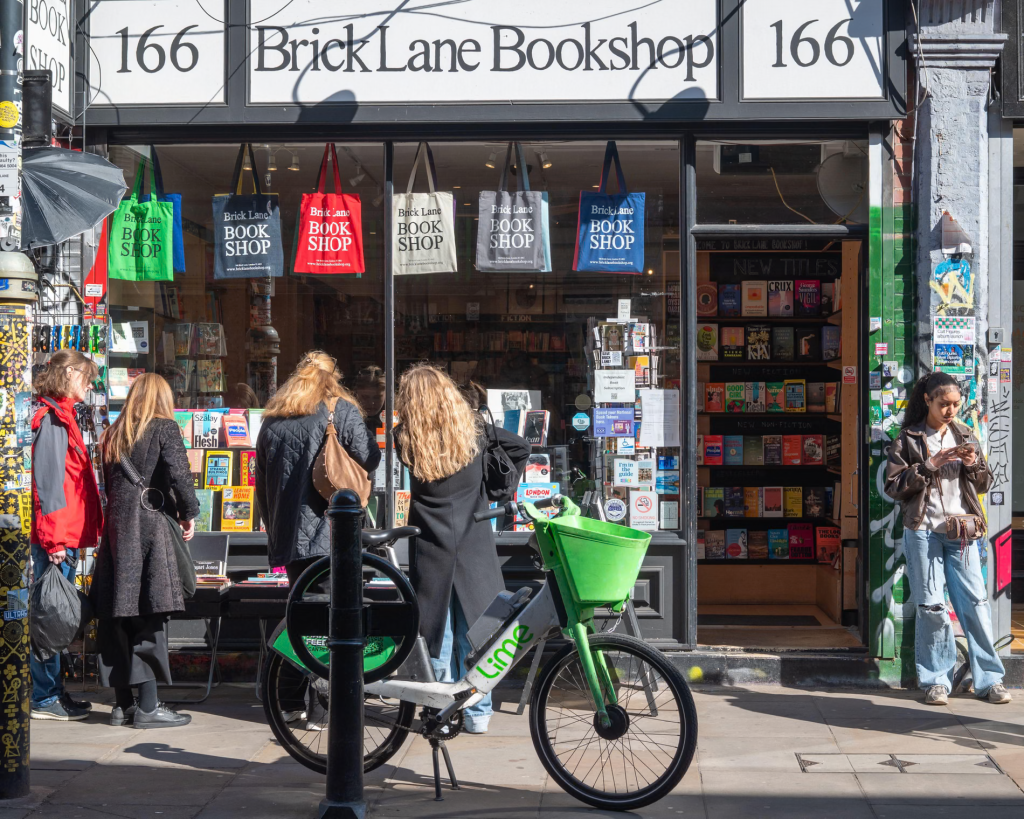
People looking at books outside Brick Lane Bookshop in London. Photo Credits: Melanie Major/Alamy
After discussions of whether or not the government would give highstreet bookshops the same economic reliefs as pubs and clubs (Loffhagen), we moved onto the advertising portion of the evening. Advertising a book event is not an unsightly thing, and it is really quite insightful to know how passionate organisers are, but the segment of the night when Lighthouse Bookshop took the stage made me lose interest. For a literary salon, half of it being about an upcoming event felt misplaced when we could have spent longer discussing that week’s theme of independent bookshops. Part of me wondered if they were taking the opportunity to promote the event because there were so many new people in the room, which as a publishing student I find as quite a good use of marketing.
Fortunately, the main portion of the evening came after the thirty-minute talks were over and when the mingling commenced. One of the organisers came around to us and mentioned how he made a point of trying to introduce himself to the Napier students each year, which really showed how dedicated the Salon was to fostering a community amongst its members. This feeling was what I took from the event at the end of the night – a desire to better integrate myself within the Edinburgh literary scene. I also recommended the event to a writer friend of mine so she could introduce herself to an environment she was just beginning to navigate. Even if I did not receive the in-depth topic breakdown I had imagined at the start of the night, I left knowing I had a place to return to likeminded people to stand and chat with.
Word Count: 526
Sources:
Laing, Audrey. “Indies in Scotland: Exploring the Unique Role of Independent Bookshops in Scotland’s Towns and Villages.” Publishing Research Quarterly [New York], vol. 36, no. 4, Dec 2020, pp. 585–600, doi.org/10.1007/s12109-020-09759-5.
Loffhagen, Emma. “Philip Pullman and Maggie O’Farrell among authors urging Burnham to cut business rates on bookshops.” The Guardian, 18 Aug 2026. www.theguardian.com/books/2026/aug/18/philip-pullman-and-maggie-ofarrell-among-authors-urging-burnham-to-cut-business-rates-on-bookshops
NEXT EVENT: September’s ‘festival’ Salon. Edinburgh Literary Salon, 14 Sep 2026. www.edinburghliterarysalon.org/post/next-event-september-s-festival-salon.

