Written by Emma Martin
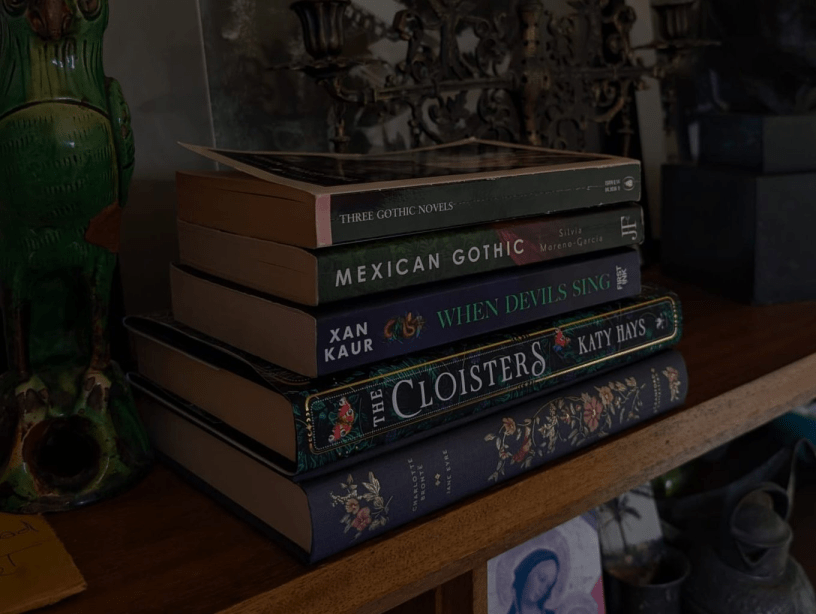
“Everyone carries a shadow.”– Silvia Moreno-Garcia, Mexican Gothic
Despite its distinguishing characteristics of isolation and decay, gothic fiction is undoubtedly alive and well in 2026. The literary genre emerged in the mid-1700s and reached peak popularity in the 1790s (Pagan, 2018), but even now, over 200 years later, readers continue to devour gothic fiction. Suspense and terror permeate these deliciously dark tales, as they explore issues from morality to psychology, religion, and more. Supernatural elements are frequently threaded through gothic narratives as a means through which to explore these issues.
While new book releases are eagerly awaited each year – no less than 82 titles have made Goodreads’ 2026 anticipated gothic reads list – classic titles such as Mary Shelley’s Frankenstein (1818) and Daphne du Maurier’s Rebecca (1938) continue to find new readers. This begs the question, what is it about Gothic fiction that resonates with readers today?
Initially emerging as a response to the Age of Enlightenment (Carlick, 2024), described by Gray (2019) as a period of “profound cultural turmoil”, gothicism speaks to the “fears and uncertainties” inherently intertwined with such cultural upheaval (Gray, 2019). More than this, at the time of its conception, gothic literature was linked with an increase in women reading. It is no surprise, then, that the genre challenged patriarchal gender ideals (The Book Habit, 2019; Gray, 2019).
Over the years, the versatile genre has branched out. Gothic fiction’s cavernous underbelly is home to subgenres including southern gothic, gothic horror, and urban gothic, each a different avenue to explore more niche social and cultural issues.
This brings us to Edinburgh: a bewitching city with “tales on every gothic corner” (MacEacheran, 2026), its aesthetic pairs perfectly with its status as a UNESCO City of Literature (UNESCO, n.d.). Throughout the city’s haunts, you will find plenty of literary events championing gothic fiction. The enduringly high demand is clear for all to see.
It was a pleasure to attend two such literary events in the first half of 2026. First, the Edinburgh Literary Salon’s March event presented an impressive line-up of three gothic fiction authors: Lyndsey Croal, Angie Spoto, and Erin Hardee. They detailed their writing journeys and explored why contemporary readers – women in particular – are drawn to this decadently dark genre. Spoto cited the escapism offered by gothic stories, as well as how they explore issues of women’s agency. Their sentiments are echoed by writer Charlie Fabre (2023) who notes, “the gothic genre is the perfect place to discuss the hardships, horrors, and expectations of womanhood”.
The second event I attended was a book launch celebrating the paperback release of Krystelle Bamford’s award-nominated novel Idle Grounds. Bamford spoke about the distinct influence of gothicism on her writing, most notably the inspiration she drew from Northern Gothic tales from the USA (Bamford, 2026).
There you have it: gothic isn’t going anywhere. Whether drawn in by its uncanny ability to hold a mirror up to societal issues, or by a desire to escape into another world, readers will continue to enjoy the versatile genre. If you have yet to explore gothic fiction, now is a most excellent time to sink your teeth in.
Bibliography
Carlick, S. (2025) A guide to gothic literature, Gothic Literature: The Essential Guide. Available at: https://www.penguin.co.uk/discover/articles/what-is-gothic-literature (Accessed: 06 May 2026).
Fabre, C. (2023) Why gothic literature is so suited to discussing womanhood, Swim Press. Available at: https://swim-press.co.uk/2023/10/15/why-gothic-literature-is-so-suited-to-discussing-womanhood/ (Accessed: 06 May 2026).
Goodreads (2026) 2026 Gothic, Goodreads. Available at: https://www.goodreads.com/list/show/240094.2026_Gothic (Accessed: 06 May 2026).
Gray, S. (2019) ‘Gothic Literature in the Eighteenth Century’, in A Guide to the Gothic. Denton, Texas: The University of North Texas Libraries. Available at: https://pressbooks.pub/guidetogothic/ (Accessed: 2026).
MacEacheran, M. (2026) Europe’s most bewitching city is closer than you think, The Times & The Sunday Times. Available at: https://www.thetimes.com/travel/destinations/uk-travel/scotland-travel/edinburgh/edinburgh-city-break-what-to-do-where-to-stay-tkw5sqh67 (Accessed: 06 May 2026).
Pagan, A. (2018) A Brief History of Gothic Horror, New York Public Library. Available at: https://www.nypl.org/blog/2018/10/18/brief-history-gothic-horror (Accessed: 06 May 2026).
The Book Habit (2019) The original goths: Why women write gothic horror, The Book Habit. Available at: https://thebookhabit.co.uk/2019/11/06/the-original-goths-why-women-write-gothic-horror/ (Accessed: 06 May 2026).
The Bookseller Editorial Team (2012) The Chills and thrills of gothic fiction. The Bookseller. Available at: https://www.thebookseller.com/features/chills-and-thrills-gothic-fiction-338744 (Accessed: 06 May 2026).
UNESCO (2025) Edinburgh UNESCO City of literature, United Kingdom National Commission for UNESCO. Available at: https://unesco.org.uk/our-network/creative-cities/edinburgh (Accessed: 06 May 2026).
 MSc Publishing – Industry Accredited Postgraduate Degree