If you studied English Literature at a red brick university, or at least perused the reading lists, you might have found a pretty androcentric catalogue. Conversely, in the romance section of your local bookshop, the authorship is often largely female. Despite being firmly into the 21st century, these archaic patterns continue to persist in the literary landscape.
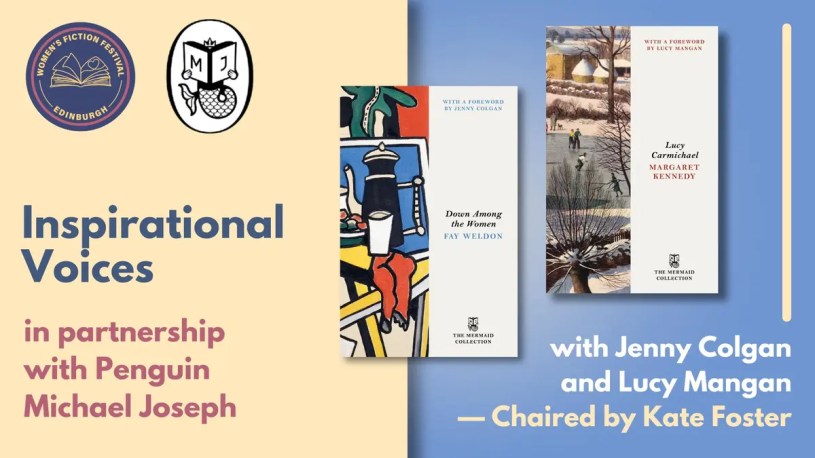
At the Edinburgh Women’s Fiction Festival this September, several big names graced the stage to discuss their thoughts and feelings around how they read and write as women, and what that reflects of our wider world. The first Inspirational Voices panel featured authors Jenny Colgan and Lucy Mangan. The conversation, chaired by Kate Foster, followed the women’s thoughts on career, criticism, and the books they consider to be essential reading.
Both writers were involved in The Mermaid Collection launched by Penguin Michael Joseph (PMJ) – a series of 7 works of fiction by women writers who have been ‘neglected’ from the literary canon featuring forewords from contemporary female novelists (PMJ cited in Wood, 2025). This marrying of old and new inspired discussion of works that the authors felt deserved a spotlight. Colgan recognised Barbara Taylor Bradford OBE and Fay Weldon, Mangan hailed the scandalised Lace by Shirley Conran (1982), while Foster cited Judy Bloom’s Forever (1975) as a scintillating read which was once confiscated from her by a teacher (2025).

On the topic of writing, the authors discussed how they had been interacted with by men. Magnan noted while male commenters posted expatiating critiques on her review of The Hack for The Guardian, the women’s responses were ‘more human and polite’ – which she noted not as ‘wimpy’, instead demonstrating a connectedness between reader and writer (2025). Colgan regaled everyone with comical tales of men at dinner parties googling her immediately after discovering she was a published author; as if her telling them wasn’t enough, they needed cold hard Wikipedia evidence (2025).
People have always been scared of women reading novels…getting their ideas from books (Colgan, 2025)
While genre fiction boasts female names across the board, the literary canon refuses to offer equal space for both sexes. Though Bronte, Austen, and Woolf may have tenured positions, the corpus spans far beyond them, and this omission can have harmful effects on women readers (Schweickhart, 1986, p.71). The importance of seeing those names listed as celebrated works provides latent justice for those ‘whose signature – not merely their voice – has not been worth the paper it was written on’ (Finke, 1992, p. 109). And the absence of female written novels also perpetuates the lack of authentic representations of said women (Robinson, 1983, p.84).
We’re still on the back foot as a sex (Mangan, 2025)
On being a female author, the panelists brought up the ‘unsettling’ effect women writers have on men to this day (2025), showing that even with the leaps and bounds the industry has made in representation, the scale is still not equalised.
Though heavy in parts, the tone of the panel remained bolstering. Colgan passionately posited:
Reading fiction, for women, is and always has been in its essence, a deeply, deeply feminist act (2025)
Bringing author names out of the shadows, and reminding us of the power that remains in picking up a book, Colgan, Mangan and Foster resolved an insightful and wip-smart look into feminism, reading, and writing.
Bibliography
Colgan, J. and Mangan, L. (2025). ‘Inspirational Voices with Jenny Colgan and Lucy Mangan — Chaired by Kate Foster (in partnership with Penguin Michael Joseph)’, Edinburgh Women’s Fiction Festival. 26 September. Edinburgh.
Edinburgh Women’s Fiction Festival. (2025). Available at: https://www.edwomensficfest.co.uk/ (Accessed 18 October 2025)
Finke, L. A. (1992). ‘Style as Noise: Identity and Ideology in A Vindication of the Rights of Woman.’ In Feminist Theory, Women’s Writing Cornell University Press. pp. 108–147
Mangan, L. (2025). ‘The Hack review – the astonishing story of phone-hacking makes for remarkably dull TV’, The Guardian. 24 September. Available at: https://www.theguardian.com/tv-and-radio/2025/sep/24/the-hack-review-jack-thorne-media-corruption-guardian (Accessed 18 October 2025)
Penguin. (2025). The Mermaid Collection. Available at: https://www.penguin.co.uk/series/MERCOL/the-mermaid-collection (Accessed 18 October 2025).
Robinson, L. S. (1983). ‘Treason Our Text: Feminist Challenges to the Literary Canon.’ Tulsa Studies in Women’s Literature, 2(1), pp. 83–98
Schweickhart, P. P. (1986). ‘Reading Ourselves: Towards a Feminist Theory of Reading. In: Bennet, A. (ed.) (1995). Readers and Reading. Longman Group Limited. pp. 66-93
Wood, H. (2025). ‘Penguin Michael Joseph to celebrate 90 years of publishing with Mermaid Collection’, The Bookseller. 13 June. Available at: https://www.thebookseller.com/news/penguin-michael-joseph-to-celebrate-90-years-of-publishing-with-mermaid-collection (Accessed 18 October 2025).
 MSc Publishing – Industry Accredited Postgraduate Degree