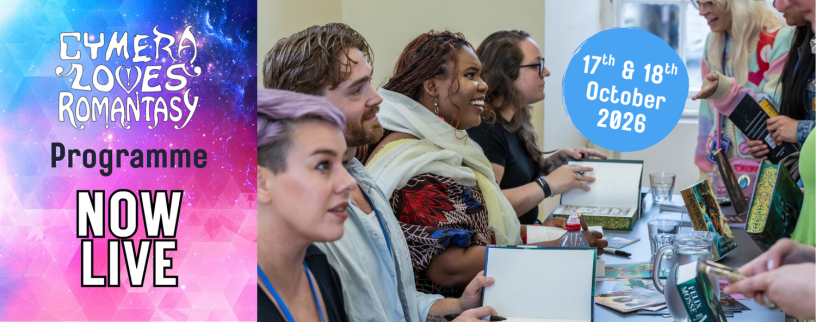
Tucked away rather unassumingly in Edinburgh University’s thriving hub, The Pleasance, is the humble but earnest Cymera Loves Romantasy Festival. Taking place over the weekend of the 16th of October, the festival serves as a sub-group of its much more ambitious sibling, the Cymera Sci-Fi and Fantasy Festival, which commenced earlier this summer.
As a tentative fan of romantasy but a devout follower of wider fantasy, I was intrigued by the festival in a city where there are few similar offerings. So, on the 17th of October, I found myself in a small room tucked away in the lower floors of The Pleasance, for a talk on ‘The Joys of Audiobooks’.
Arriving in the room, I was met with a rather sparse spread of attendees compared to the available seats, denoting that the panel had perhaps hoped for a stronger turnout. But this did not mean that the audience were any less enthused to be there, as I noticed several eager faces. This excitement was likely due to the appearance of Shiromi Arserio, an accomplished and lauded audiobook narrator and actress who was both a 3-time ‘Audie’ finalist and a Pencraft Literary Award winner. Joining her was Heather Palmer, a Scottish writer with a passion for the gothic, the dead, and the nature that surrounds us. They are also the author of the ‘Eynhallow Saga’, which can be found on Audible.
Personally, I have always advocated for physical books; there’s nothing I love more than curling up with a tangible book in my hands, to see love and time wear on its spine and pages with use. But I was certainly intrigued by the promise of the ‘joy’ to be found in audiobooks, and, taking my seat, I felt certain that I was in very capable hands with Arserio and Palmer.
As the panel commenced, I was delighted by Arserio’s warm, bubbly enthusiasm, and thrilled by her endearing voice impressions, allowing her to transform easily from the American deep south to a refined British lilt.
I discovered how the process of getting into character varies between audiobooks, and, curiously, how in a literary world where many grow weary of tropes, they prove incredibly useful for understanding the characters and relationships that the narrator brings to life.
The audiobook process does not prove to be consistently straightforward, however. Both Arserio and Palmer brush up against frustrations in their daily jobs, most notably a disconnect between publishers, authors, and themselves. Often, almost no communication will be facilitated between narrators and authors, with the publisher ferrying the little discussion there is between them.
Social media and its increasingly vital role in publishing also proves to cause friction, especially for those who may not be well versed in it, and navigating the promotional process can be stressful. Audiobook narrators who may prefer that their likeness usually remains detached from the final product are now pressured to promote themselves and their material on social media, adding yet more tasks to an already considerable workload.
Additionally, similar to the ‘Big Five’, there are a handful of audiobook platforms, such as Audible, which dominate the market. I find myself hoping that there should be more ease of access for what is, at its core, a fundamentally more accessible form of literature, perhaps even through local libraries.
Coming out of the ‘Cymera’ panel, I’m not sure that I’ll be convinced to entirely make the switch from physical books to audiobooks. But, what I am certainly filled with is a newfound admiration and curiosity for audiobooks and those who narrate them. This becomes especially true as professionals such as Arserio and Palmer find their everyday work is becoming increasingly demanding and difficult to navigate as the industry attempts to modernise and appeal to wider audiences.

