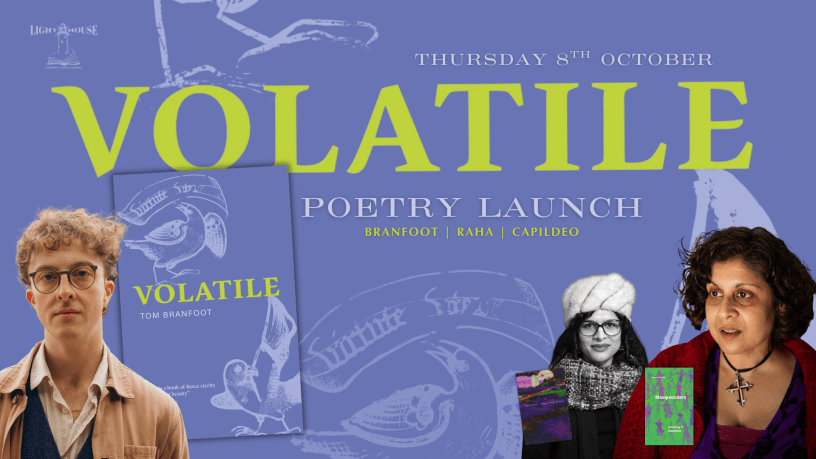
Upon arriving late to Lighthouse – Edinburgh’s ‘Radical Bookshop’ – in a dismal October storm, I realised that this was a mask-mandatory event. As I often experience, those most displaced from a government’s failings seek community in such hopeless times; it therefore tracked that so many immunocompromised people, myself included, find solace and connection in our local bookshops.
I am greeted by kind eyes and floor-to-cieling bookshelves rich in literature to educate the masses on how to survive geopolitical collapse: Lighthouse, eponymously, offers solace within the storm of environmental devastation outside. I donned my mask and took my seat to hear Tom Branfoot guide us through his debut poetry collection Volatile, “what means collapse and also to fly” in Middle English (Branfoot, 1), linking displaced humans around the world to birds in search of new homes.
Branfoot’s poetry navigates the concept of displacement and volatility in its many forms, from the Gaza genocide (Cuckoo Song), fascism and technology (Intervals) and even through Branfoot’s own childhood with an alcoholic mother: when reading from his poem Mother Triptych, Branfoot and I locked eyes across the room as he reads “your third christmas alone / capillaries roquefort-veined / in stale columbaritude” (Branfoot, 5) and between us flash a mutual understanding of what it means to grow up amongst addiction, alone and stronger than a child should be.
We discussed this solemnly afterwards as he signed my copy of his book. It is an understanding that shouldn’t exist, a mark of resilience mistaken for a scar. To love someone is to accept their flaws; yet to love a family member lost in addiction takes blind faith and resigned acceptance in equal measure. The poem ends with “memory is kind: a kind / of unlistening” (Branfoot, 5). Branfoot touched my heart unexpectedly in his experience of grief, documented so beautifully through birds.
Branfoot captivates the room with his closer, A Parliament of Jets, which opens with a quote from Gazian birdwatcher Saed Shomaly – “If I die, I worked for Palestine – and I worked for the birds.” (Vidal). Branfoot performs with gasping breaths and ritualistic passion, rousing the audience as he brings to attention the danger birdwatchers in Palestine face to experience nature: “only drones are permitted optical advantage / one risks existence to witness a kestrel return to its nest in the West Bank’s limestone cliffs.” (Branfoot, 64).
Branfoot then juxtapositions this danger with the “recreational environment / constructed and purchased by Englishmen to preserve national identity”, which is now “ruptured” by “low-flying American-made jets” (Branfoot, 65), to remind us of the UK’s involvement in the Gazian genocide, and how war displaces us all, even in an anglo-saxon idyllic countryside. I was lost in a spell of F-15 fighterjets, the machines of war transmogrified into a curse through Branfoot’s delivery, a hex upon the destruction of land and air as he proclaims “I don’t see that there should be separate words / for politics and nature.” (Branfoot, 67).
Branfoot helped us all at Lighthouse reflect on the emotive power of words, the instability of a home, and the connection we share as living beings, whether we find freedom in flight or fear what may drop from metallic wings. As with any successful poetry night I left disturbed, and grateful, leaving the bright intimacy of Lighthouse and back into the dark rainy night.
Bibliography
Branfoot, Tom. Volatile. 1st edn, The87press, 2026.
Vidal, Marta. ‘“Sometimes I Wonder If I’ll Come Back”: Palestinian Birdwatchers Defy Danger to Scan the Skies’. The Guardian, 6 June 2024. Environment. The Guardian, https://www.theguardian.com/environment/article/2024/jun/06/palestine-gaza-west-bank-nature-birds-birdwatching-aoe.

