
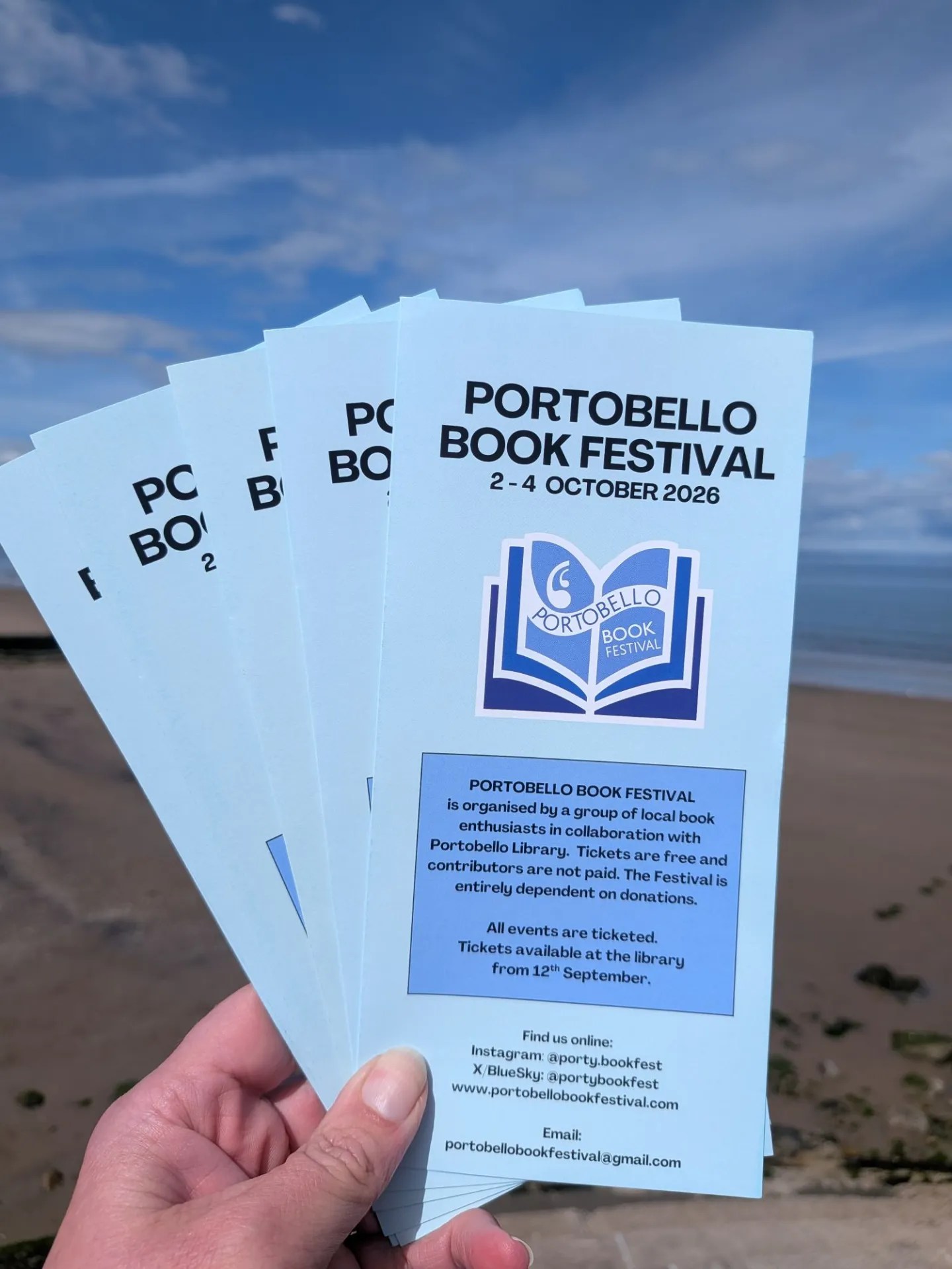
On a whim I decided to join my fellow classmate on Friday the 2nd of October in the Portobello Library to listen to the talk The Male Anti-Hero: Bad Boy or Good Guy?. The event was part of the Portobello Book Festival this year and was advertised with the following paragraph:
Building on a long tradition of Scottish anti-heroes, author Kevan Christie (To Be Frank) talks about what makes an anti-hero, whether rogues can be truly loveable, and why Edinburgh makes the ideal setting for their stories of chaotic behaviour. (Joanne)
We had expected a talk on the literary role of the anti-hero and how, specifically the male version, is being presented in different works of fiction. However, what we were presented with was not a discussion of literary devices, but rather with a book launch of Kevan Christie’s new book To Be Frank.
The book, set in Portobello, Edinburgh, describes the story of Frank, a newspaper columnist who rises to sudden fame, after writing “a controversial piece calling for dogs and babies to be banned from cafés” (Christie). He faces further troubles when his estranged daughter, who works for a syndicate in London, moves back to Portobello and works alongside Frank’s arch-enemy (Christie).
At the beginning of the talk with chair and librarian Paul Hudson, Christie paints his main character Frank as the anti-hero of the story. Christie drew inspiration from numerous Scottish literary anti-heroes, such as “Sick Boy” from Trainspotting. Whether Christie views Sick Boy as a villain or anti-hero of the story was not quite clear. Originally, Frank was not planned as an anti-hero. Christie describes him as a caricature of a middle-aged man, who sees himself as anti-establishment with “typical guy behaviour” as Christie put it, such as sitting in a pub and so on. This doesn’t automatically make him an anti-hero. Yet, Christie kept referring to Frank as such.
Another important character Christie kept talking about is Brewster, the “apparently reformed racist, homophobic football hooligan turned drug dealer” (Christie). Brewster is presented as an anti-Frank. So, does this mean he is the hero to the anti-hero or rather a villain, which seems more to be the case? A discussion on whether the anti of an anti-(Frank)hero is a hero, was something I would have originally expected from an event titled The Male Anti-Hero: Bad Boy or Good Guy. But no, according to Christie, he views the hero as someone who knows what to do and the anti-hero as someone who cares, but doesn’t know how to express themselves. Further in the talk, Frank is also described as a flawed hero. Now, whether a flawed hero and an anti-hero are the same thing or not is up to debate, but from Frank’s character description, it certainly seems to be fitting. To see if Frank truly makes a heroic attempt to redeem himself (Christie), one has to read the book.
The event also included a short preview of Christie’s second novel, which is currently in the works. That story will focus on the women in Frank’s life, since, as Christie put it “women are the strength [and] moral compass”.
To avoid further disappointment or confusion, it might be helpful for future book festivals to categorize the events held as talks, book launches, workshops, and so on.
Works cited:
Joanne. „The 2026 Portobello Book Festival Programme is now available!“ Portobello Book Festivale, https://portobellobookfestival.com/2026/09/02/the-2026-portobello-book-festival-programme-is-now-available. Accessed 18 October 2026
Christie, Kevan. Kevan Christie, https://www.kevanchristie.com. Accessed 18 October 2026

