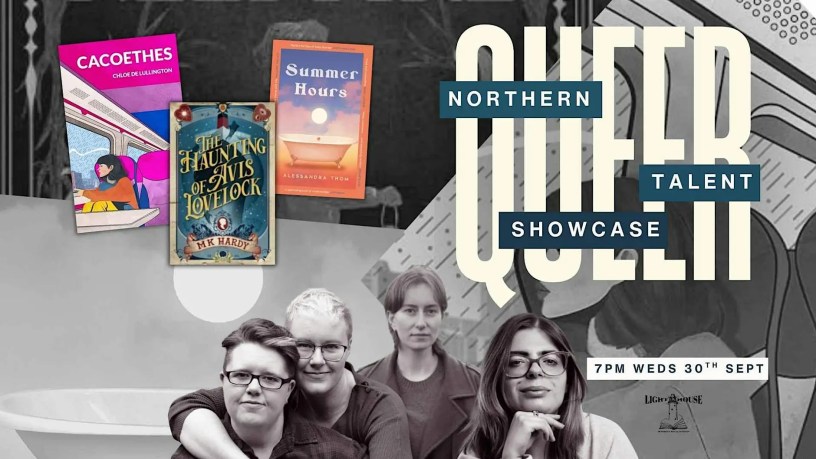
On September 30th, Lighthouse Books, ‘Edinburgh’s Radical Bookshop’, held an event titled ‘Queer Showcase: A night of northern talent’ in its small, cozy non-fiction room. In typical Lighthouse fashion, the event was chaired by Lighthouse staff, and began with Pao, one of the shop’s resident booksellers, welcoming everybody and giving a short run-down of the event’s structure. Pao then introduced the authors: MK Hardy (the pen name for Morag Hannah and Erin Hardee), a collaborative duo of writers who live and work in Scotland; Chloe de Lullington, an author and screenwriter based just outside of Manchester; and Alessandra Thom, a Scottish author based in Edinburgh, whose novel Summer Hours, an atmospheric novel about queer friendship and desire set during “a hot Edinburgh summer” was published in June 2025 by Polygon (Birlinn). Each author then read a short excerpt of their respective novels, followed by a forty five minute question and answer session chaired by Pao.
One of the strongest themes interwoven throughout the event was the question of place, both in terms of novelistic setting and the industry itself. This discussion was set in motion by Pao, who noted that all three novels were noticeably driven by a “strong sense of place”, leading to the question of whether this was simply a by-product of plot, or something more akin to a socioeconomic reaction to the increasing gentrification of the northern localities that this event intended to celebrate.
When discussing her novel Summer Hours, Thom argued that Edinburgh’s unique affliction with “hippie-dippy middle-class bullshit” meant she really couldn’t have set the story anywhere else, and that her humanly flawed, “judgemental” and pessimistic protagonist Roisin found a fitting home in Edinburgh, which is currently undergoing the kind of city-wide rent crisis that has the capacity to leave vulnerable people such as Roisin in unsafe, often “transactional” situations. This setting provided the perfect backdrop for an exploration of boundary crossing, paralysing secrecy and housing and wealth inequality. The impact that housing instability could have on a character like Roisin, who is already “so in her head about things”, was important for Thom to explore within her writing, “especially in a city like Edinburgh”, where neighbourhoods such as Leith Walk have become “the poster child for gentrification” (Thom).
The notion of place was clearly intrinsic to the fabric of the event itself, which aimed to celebrate specifically northern talent. When discussing the setting of her novel Cacoethes, de Lullington said she “didn’t want it to be a London book”, as “a lot of things, publishing things in particular, are quite London-y”. This statement opens up an important question about the industry as a whole: about which voices it celebrates, and which settings act as the backdrops for the stories we read. This is a question that Lighthouse aims to face head-on, as it continues to centre and uplift marginalised voices within its author events, and open up important discussions around place and belonging.
The full event is available to watch on Lighthouse’s website or YouTube channel.
Works cited:
“Queer Showcase: A night of northern talent.” Lighthouse | Edinburgh’s Radical Bookshop, 30 Sept. 2026, lighthousebookshop.com/events/queer-showcase-a-night-of-northern-talent.
“Summer Hours.” Birlinn, birlinn.co.uk/product/summer-hours-2/.

