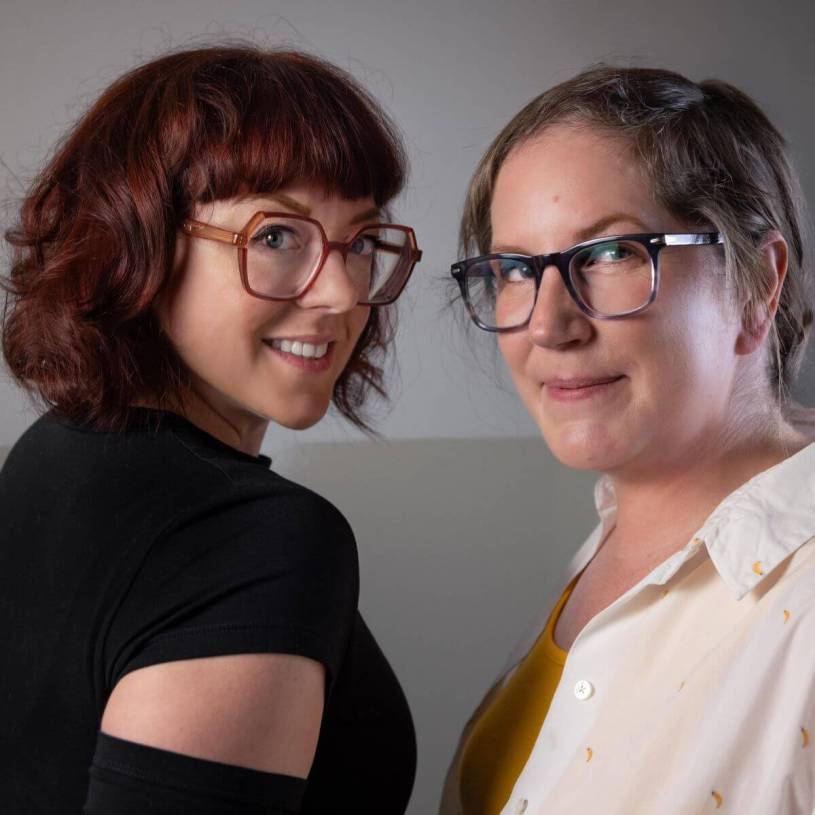
On Sunday, 23 August 2026, the Edinburgh International Book Festival hosted V. E. Schwab and Cat Clarke to discuss their new co-written thriller, The Ending Writes Itself. As a long-time fan of V. E. Schwab’s work, I was immediately intrigued to learn that she had not only written a new novel but also co-written one with an author I was not familiar with. As someone who has never personally read a co-written novel, I was intrigued by the story behind its creation and how co-writing worked as a process. However, I did not expect how quickly the discussion revealed that their new novel was not only a thriller but also a commentary on their personal experiences in the publishing industry.
The event started with a brief synopsis of the book from both Clarke and Schwab, but what was even more interesting was learning how they agreed to co-write the book in the first place. Schwab, for instance, said she would never choose to co-write a book because she believed her creative process wasn’t compatible with shared writing. Clarke actively spoke out against writing another book, having left the publishing industry years earlier for what she called the “far saner shores of TV and film.” It was not until Schwab met an agent who told her about an author working on a novelisation of an IP project that she pitched The Ending Writes Itself to Clarke. After the initial pitch, Clarke noted that writing this book, about authors trapped on an island by a publisher to finish a deceased author’s novel, would be the perfect opportunity for them to air their grievances about their own experiences with publishing.
When asked about co-writing the book, Clarke described it as “like building a house”, while Schwab said co-writing required a “real collaborative spirit.” Their explanation of co-writing as a process was interesting: how a creative act that many feel is so deeply personal could so easily become something jointly experienced. For Schwab and Clarke, however, co-writing did not stay merely a process; it quickly became a feature of the novel itself. In the book, a pair of characters co-author, adding a metafictional lens to their work. The Ending Writes Itself is not simply a story; it is a commentary on writing practices and what exactly it means to be an author. It also sheds light on what the publishing industry is truly like for writers. Schwab and Clarke write similarly to R. F. Kuang’s Yellowface, drawing on their own real-life experiences or those of close friends in the industry. For Schwab and Clarke, writing this book was not simply about releasing another story; as Schwab states, it was “a promise of catharsis.” Schwab and Clarke both believed many aspiring writers misunderstand what it is actually like to get work published, and through works such as The Ending Writes Itself and Yellowface, they pull back the curtain on the industry, removing the romanticisation some people place on the process.
For those interested in watching the full interview:
https://www.edbookfest.co.uk/on-demand/evelyn-clarke-the-ending-writes-itself
Event Referenced
Clarke, Cat, and Schwab, Victoria, and Steed, Cailean. “Evelyn Clarke: The Ending Writes Itself.” Edinburgh International Book Festival, 23 Aug. 2026, Edinburgh Futures Institute, Edinburgh, Scotland.

