Aberfoyle Book Festival was held in the village of Aberfoyle from 9th to 11th October 2026.
Established in 2022, the Aberfoyle Book Festival returned for its fourth year, hosting a variety of events, including author sessions. I was fortunate to attend the session “Claire Mitchell and Zoe Venditozzi in Conversation”, held on the final day of the book festival, where they discussed their Sunday Times Bestseller ‘How To Kill A Witch: A Guide for the Patriarchy’.
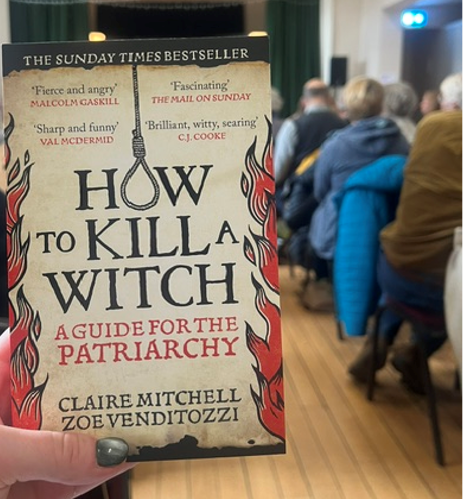
– Photo taken by Ellie Paterson at the Aberfoyle Book Festival 2026, October 11.
Mitchell, Venditozzi, and Dorothy Parker (chair of the event and Aberfoyle resident) discussed the underlying misogyny of the witch trials of Scotland, and how this issue prevails today.
During the talk, it became clear that there was a lack of research regarding the witch trials of Scotland – and, generally, a lack of women’s stories being told. They spoke of how, in Edinburgh’s city centre, for example, you will find statues of men – male authors, philosophers – even a bear – but no women. Art UK noted that “there are currently more public statues of named animals than of women in the centre of Edinburgh” (Rhona Taylor, 2018). This shocking fact has made me think more closely about the waves of misogyny that have continued into modern times. Women’s stories, their true stories, will remain unheard unless we do something about it.
“Remembrance is resistance.” (Venditozzi, 2026)
One part of their book they discussed was the reasons behind King James VI’s Daemonologie. This wrote that the devil and the devil’s witches (i.e. the accused women) were present at “God’s will” (Mitchell, 2026). According to this publication against witches, there were three types of people – the bad, the good, and everyone in between. (Mitchell, 2026). It ultimately became the foundation for convicting many people, predominantly women, of witchcraft. We can see how this publication was used as a means of punishment, censoring, and control of women.
We see this censorship of women continue today, particularly with female authors. For example, Mitchell and Venditozzi discussed how the title of their book, alongside some of its contents, had to be altered for its American readers. The title was changed to How To Kill A Witch: The Patriarchy’s Guide to Silencing Women. As the authors noted, “silencing women” is the exact opposite of what they wanted to achieve. They were told that their US publishers did not believe that US readers would be able to comprehend fiction and non-fiction simultaneously. Personally, this feels more like suppression of the truth than it does a practical matter.
“Women were not safe then; women are not safe now.” (2026)
We need to ask ourselves: what can we be doing better? How can we change the way we tell women’s stories, so as not to suppress their voices and repeat the mistakes of our past?
To finish, I leave this excerpt from ‘In Memoriam’ by Len Pennie, demonstrating the importance of continuing to publish women’s stories:
“…A state sanctioned murder ae innocent fowks,
Punishment lackin a crime,
…We’ll aye scrieve yer name in books they cannae burn,
Write a legacy never tae die.”
Sources:
Aberfoyle Book Festival 2026 – Friday 9th October to Sunday 11th October 2026
Scottish witch trials campaign — Witches of Scotland
Where are the Women? (2019) — Sara Sheridan
King James, the First: Dæmonologie (1597).
Where are the statues of Edinburgh’s famous women? | Art UK
The stories of the women accused of being witches must be told | The National
Literary Events:
Mitchell, C., Venditozzi, Z. (2026). Claire Mitchell & Zoe Venditozzi in Conversation – Chaired by Dorothy Parker, Aberfoyle Book Festival. 11 October, 2026.

