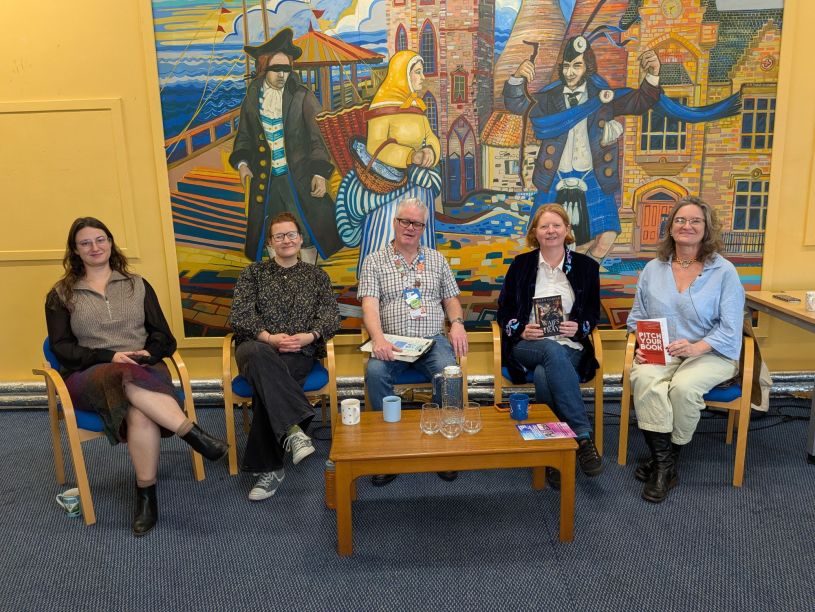
On the third of October 2026, during the annual Portobello Book Festival, the library hosted a panel titled, “From Writers to Readers”. Of the group were Sheila M Averbuch (acting as moderator, but also a published author), Helen Harper (a self-published author), Paul Hudson (a librarian), Ann Landmann (a publishing representative and founder of the Cymera Book Festival), and Elise Lenzi (a local bookseller). Together they discussed how each ended up in the world of books, how much editing is required of a book’s first draft, the importance of advertising your book correctly, and how bookshops go about scheduling events. What I found most interesting was their discussion on self-publishing, and how that impacted an author’s experience in the industry.
Helen Harper (a pen name chosen while she was working as a teacher) fell into writing as an after-work hobby until she realized she was 50k words deep into an urban fantasy novel and nowhere near done. More than ten years and 90 books later, she is still self-publishing. Since Harper initially came into the industry as a hobby writer, self-publishing was a way for her to publish with the least amount of work outside possible. On the other hand, Sheila Averbuch was a traditionally published author of children’s books with Scholastic. In 2026, when she went to publish her first nonfiction book, her agent recommended her self-publish. When in children’s fiction, it is extremely hard to garner a following since your audience is mostly parents buying books for children who eventually age out of them. For a nonfiction informational book, however, it is much easier to gain that traction. One thing the panel noted was the difficulty for self-published books to be sourced in bookshops and libraries. Per Elise, it is tough for bookshops to navigate organizational logistics because you must individually talk to each author you plan on stocking books from, as opposed to the whole publishing imprint.
Another topic the panel brough up was the prevalence of social media. How does it affect the industry and help or harm you as an author? Ann pulled from her publishing background, saying that right now publishers are publishing too many books. There is no way they can do everything, so they like authors who already have that following built-in. Nevertheless, Harper commented that she does not really have social media. With her first book coming out before Covid and the massive boom in social media marketing, she found her fanbase first, and her connection to them via Facebook second. On the distributor side, Paul and Elise both said that picking authors for events has nothing to do with their following, but it does help when advertising it. Being able to digitally promote your book launch or cross-post an upcoming panel may not be a dealbreaker, but it is certainly helpful.
This panel was a wonderful resource for budding authors who want to publish in the future. The collection of different backgrounds in the industry created an environment of people that had insight into every part of getting your book into the world, and I cannot thank the Portobello Books Festival enough for creating such a well-done event.
Averbuch, Sheila M., et al. “From Writers to Readers.” Portobello Book Festival, 3 Oct. 2026, Portobello Library, Edinburgh, Scotland.
Image Credits:
Portobello Book Festival. “From Writers to Readers.” 2026. Portobello Book Festival, WordPress, 8 Oct. 2026, portobellobookfestival.com/2026/10/08/a-selection-of-photos-from-portobello-book-festival-2026/#jp-carousel-4136.

