Written by Jen McCarroll
A few weeks ago, I had the privilege of attending the London Book Fair, one of the largest publishing conferences in the world. Whilst the event was vast and had representation from all corners of the industry, there were some clear main themes throughout the three-day event. The one that stood out to me the most was the focus on the rise of global literature in the UK market.
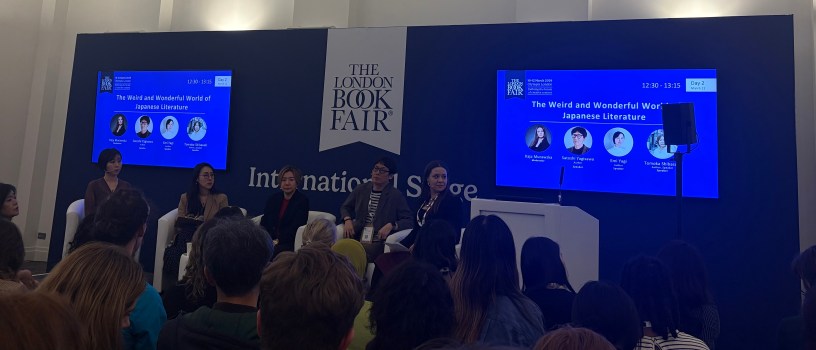
I attended a talk titled ‘The Weird and Wonderful World of Japanese Literature’ which was a fascinating experience. This was the only panel of the Book Fair in which I had to queue for in advance. I was lucky enough to get a seat, but many were standing around the perimeter of the room and even sat on the floor, which just speaks to the sheer popularity of this topic.
The panel featured three Japanese authors; Satoshi Yagisawa, writer of ‘Days at the Morisaki Bookshop’, Emi Yagi, writer of ‘Diary of a Void’, and Tomoka Shibasaki, writer of ‘Spring Garden’, and was chaired by Kaja Murawska, who wrote for the ‘Publishing in Japan’ edition of Publishers weekly.
What made this talk so different to the others I attended at the fair is that the entire thing had to be translated live. The chair does not speak Japanese, and the three authors do not speak English, and the audience was a mix of English and Japanese speakers. Therefore, the translator had to listen to the question from the chair, repeat it in Japanese to the authors, and then repeat their respective answers to the chair and us, the audience. It was so interesting to see this happen live, and I was in awe of the skill required by the translator to connect the language barriers.
One of the most interesting questions asked was about the differences in reader reception around the world; if there was anything the authors had noticed when seeing their stories go global. To my surprise, all three of the authors agreed that there were actually very few differences in how different audiences respond to a text. On this point, Satoshi reflected that often readers seek out stories to experience perspectives unlike their own, many also feeling they can relate despite the book being based on a Japanese societal experience.
These stories wouldn’t be able to have the global enjoyment they do without the work of translators. When asked about the relationship with translators, Satoshi said he has a close relationship with his translator and trusts him completely to maintain the simplicity and rhythm of his writing style. Tomoka said that after being translated into English first, the book goes from there into countless different languages, so ironically, it takes a separation from herself and the text to make it accessible around the world.
This talk was really insightful as someone interested in translated literature to get a glimpse into what it’s like for an author to see their book travel beyond them. Thank you to London Book Fair for platforming this panel, to the three authors for their valuable time, and to the talented live translator for making the talk accessible to everyone.
 MSc Publishing – Industry Accredited Postgraduate Degree