
‘Teamwork is the ability to work together toward a common vision. The ability to direct individual accomplishments toward organisational objectives. It is the fuel that allows common people to attain uncommon results.’
Andrew Carnegie1
The International Magazine Centre, in collaboration with Edinburgh Napier University, hosted the ‘2024 Magazine Challenge’: it was a particularly pivotal experience for me in my publishing studies. It was the first time I could concretely conceptualise how a creative team of people from different specialist areas may come together to create a publication. It was not only deeply satisfying that after four and a half days, our team of eleven students was able to produce a full twenty-page magazine, but it was also incredibly personally affirming. Our team instantly came together and worked harmoniously together right from the first meeting at the drawing board.
When the word ‘sport’ was drawn for the magazine topic, my first response was one of instant panic: ‘Oh no!’ I thought, automatically conjuring up images in my mind of burly figures on a field playing football, rugby, or some other team sport I know nothing about. ‘Travel’ was the next word drawn; at this, I let out an exhale, ‘Okay, this I can weigh in on’, I thought. I love travelling. Nonetheless, I was still concerned I had nothing to offer this group. Even though I have always believed that it’s objectively untrue that anyone is more or less valuable to a group inherently, I walked in the first morning, already mentally undermining myself and my ability to contribute meaningfully to the project. When other members of the team later came and asked me for direction or advice, I was floored! This was a sentiment I later found out was shared with the other two publishers.
The magazine was to be a consumer title. One of my publishing peers was designated as our team project manager, which was a relief in some way to alleviate the concern of having to vie or default to some makeshift hierarchy. As it turns out, the project manager role assignment was spot on. Our group leader had the experience, temperament and vision necessary to fill the role, and ultimately, because everyone in our group respected their leader, their peers and their own responsibilities, the few days went very smoothly. As one of the three publishers, I was tasked to advise the other groups when they requested it, edit the articles and write the editor’s letter (the project manager deferred this task to me).
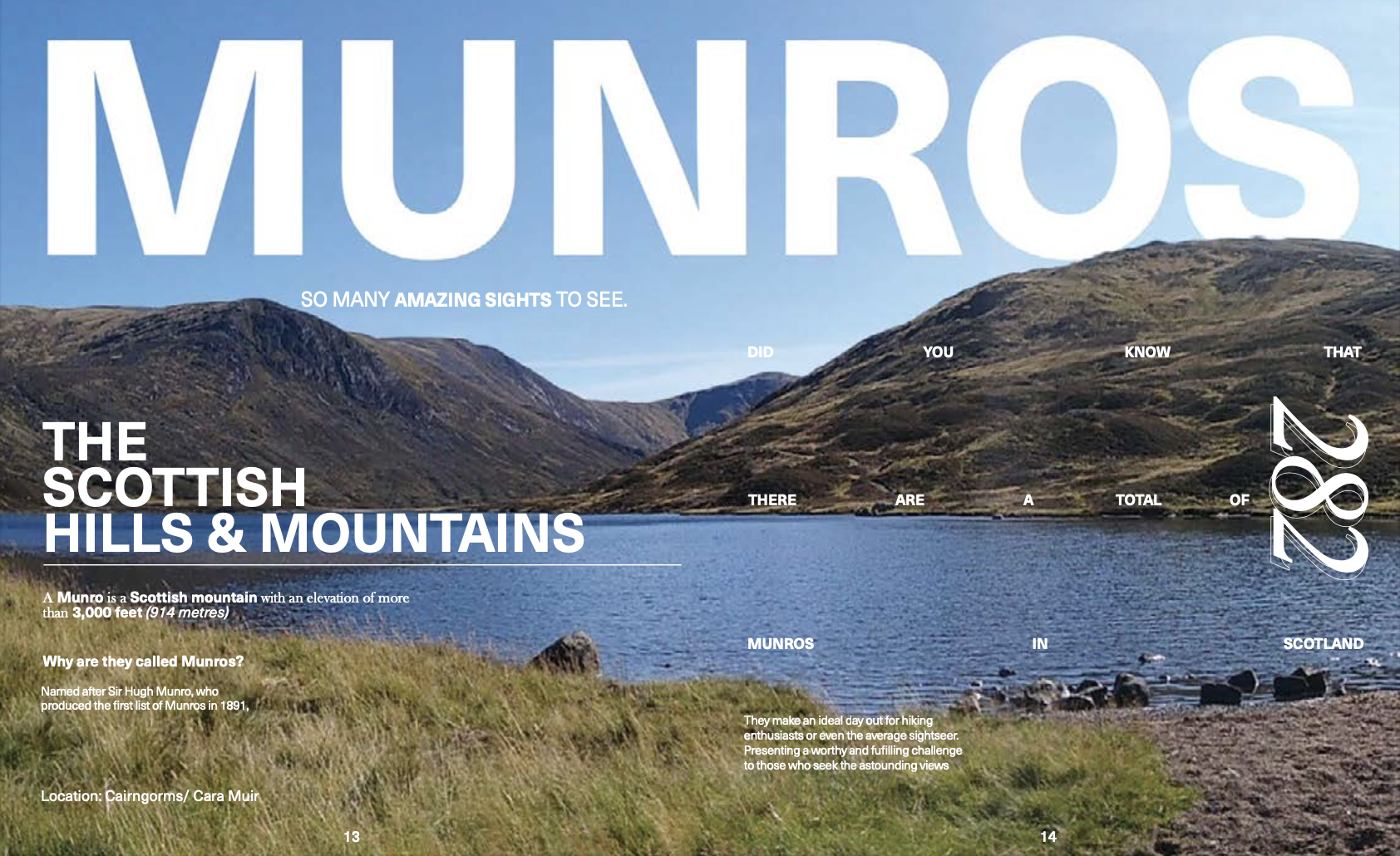
Early in the gameplan concept, we decided that although it was to be a travel magazine, each issue would focus on one country and examine its culture, people and traditions through its sports. As we were allowed to choose which imagined issue of our magazine we would print, we decided that ours would be our first. Where better to start the inaugural issue of our magazine than the birthplace of the magazine itself? Because of easy access and a shared interest in nature photography, we collectively contributed to a drive with hundreds of photographs taken in Scotland. Our one team photographer selected, edited and added to our vast collection of images for the magazine, collaborating with the graphic designers to find the best images for each spread.
My early hesitation was quickly put at ease by our decision to feature sports that can be undertaken in a group or alone, such as hiking, wild swimming, highland dancing, etc. Even though I felt much more at ease with the subject areas, I soon realised that the magazine’s subject, for the publishers, is only one out of many important aspects. If the journalists had, or at least were able to acquire, the knowledge to write the articles about the various sports, we had the contents down. Our role as publishers was primarily to know our audience. With that, we were then able to cultivate an aesthetic, a standard, a tone, an approach, an aim and a house style to apply to our magazine, ‘Gateway To’. We were responsible for liaising with the ‘departments’ of graphic design, journalism and photography to delegate work, create actionable timescales, edit, proof, and then market our product. The nature of this experience meant that it was immediate, not only the conception and creation but also the communication; I loved this aspect of the work.
In 2019, the Harvard Business Review found that employees typically waste a third of their day emailing on matters that have little to do with their jobs.2 It can be noted that this finding was prior to most remote working schemes, so this figure may have increased over the years. Our ability to communicate with each member of the team instantly meant that we could ensure that everyone was happy with every decision. Although we had a team leader, we wanted the group to function as non-hierarchically as possible; we were a democracy and we ensured everyone knew their opinion was important. The title of the magazine was a testament to this; it had to be voted unanimously, or else it wouldn’t pass.
Each team had immense mutual respect, which made this experience very enjoyable and was a perfect example of how a creative team can come together and produce something beautiful. We are all very proud of the magazine we created, and we can’t wait to see it in print later this year.



References:
- Peus, C. (no date) Teamwork and leadership in the Digital age, Lehrstuhl für Forschungs- und Wissenschaftsmanagement. Available at: https://www.msl.mgt.tum.de/rm/research/teamwork-and-leadership-in-the-digital-age/ (Accessed: 14 April 2024). . ↩︎
- Bersin, J. and Zao-Sanders, M. (2021) Making learning a part of everyday work, Harvard Business Review. Available at: https://hbr.org/2019/02/making-learning-a-part-of-everyday-work (Accessed: 14 April 2024). ↩︎
 MSc Publishing – Industry Accredited Postgraduate Degree