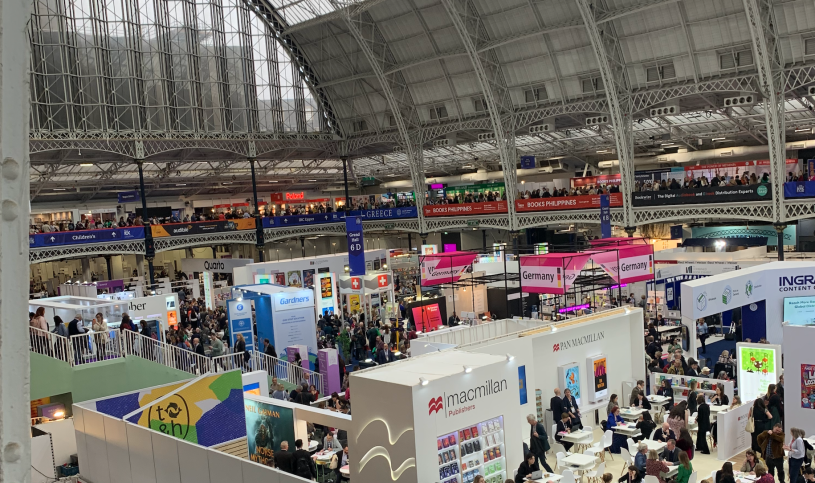
One of the hottest topics at London Book Fair this year was AI and how it is and will be affecting the publishing industry. Over the three day event there were many different talks on AI and how it affects different areas of the industry, including illustrators, authors, trade publishing, and academic publishing, as well as many more. On the first day of the fair, I attended a talk called Publishers, Copyright and AI: Taking Control. The talk was chaired by Chris Kenneally and featured Claire Harper and Sarah Fricker. Kenneally works at the Copyright Clearance Centre, Harper works at Sage, and Fricker works at IOP Publishing Limited. Within the wider creative industries there has been lots of talk of the potential threats that AI poses regarding morality, legality and the general quality and quantity of jobs being affected but it. However, this panel spoke about the positive sides to AI and how it can be used responsibly to aid publishers with tasks such as formatting to increase productivity and efficiency. They also discussed copyright issues and the importance of licensing for those who want to train Large Language Models (LLM). Nader Rifai states that ‘[p]ublishers’ main fear from LLMs is the possible increase in generating fake, yet convincing, scientific reports” (Rifai, 2024). This stresses the need for both quality checks of the content produced by AI and also of the content being used to train it.
The panel discussed using AI in responsible ways and the importance of getting a collective license in place for publishers who are willing to let their texts be used for training LLMs. They spoke about the importance of knowing that LLM’s are being fed high quality information that is factually correct to ensure that it’s output is as factually correct as possible and suggested that the best way to do this would be by allowing them to input their own peer-reviewed work. It was agreed by all on the panel that the best way for ensuring that quality work was fed to LLM’s was by introducing collective licensing. Daniel Gervais, from the Copyright Clearance Centre, suggests that “[a]s there are innumerable right holders, all over the world, whose copyrighted material has been or can be used for ML [machine learning] purposes, a collective licensing solution would seem like the most logical step forward” (Gervais, 2023). Collective licensing not only protects copyrighted works but also allows smaller publishing houses to benefit as they would not necessarily be reached out to if individual licensing was used. Moreover, it can set out terms that requires those who use LLM’s, such as Chat-GPT, during the writing of their own work to be transparent and disclose this fact.
Attending this panel at London Book Fair was very eye opening to me. As someone who has previously been very focused on the fears and anxieties that have come with the development of AI in the creative industries, I found it very beneficial to hear about not only how collective licensing can protect intellectual property but also to see how AI itself can benefit publishers. It also served as a nice reminder that AI is something that can actually benefit those is the publishing industry, as long as it is used responsibly and regulatory guidelines are established and upheld.
References
Gervais, D., 2023. AI and Collective Licensing. [Online] Available at: https://www.copyright.com/wp-content/uploads/2023/10/Collective-Licensing-Artificial-Intelligence-Paper.pdf [Accessed 21 March 2024].
Rifai, N. (2024). Large Language Models for Scientific Publishing: Please, Do Not Make Them a Foe. Clinial Chemistry. 70(3), pp.468-470. [Online]. Available at: https://academic.oup.com/clinchem/article/70/3/468/7609500 [Accessed 21 March 2024].
 MSc Publishing – Industry Accredited Postgraduate Degree