Over the last couple of years, the publishing world has witnessed a rapid decline in reading statistics. With alarming headlines announcing that fewer than 1 in 5 people between the ages of 8 and 18 are reading in their free time. (Clark et al. 2025) But how can this statistic be challenged? If we consider other forms of reading, from social media to movies and shows, people are constantly engaging with content in their free time, even if they are unaware of it. At this year’s IPG conference, Liz Cross, Managing and Publishing Director at David Fickling Books, challenged the mindset that reading among young people was in decline. (2025)
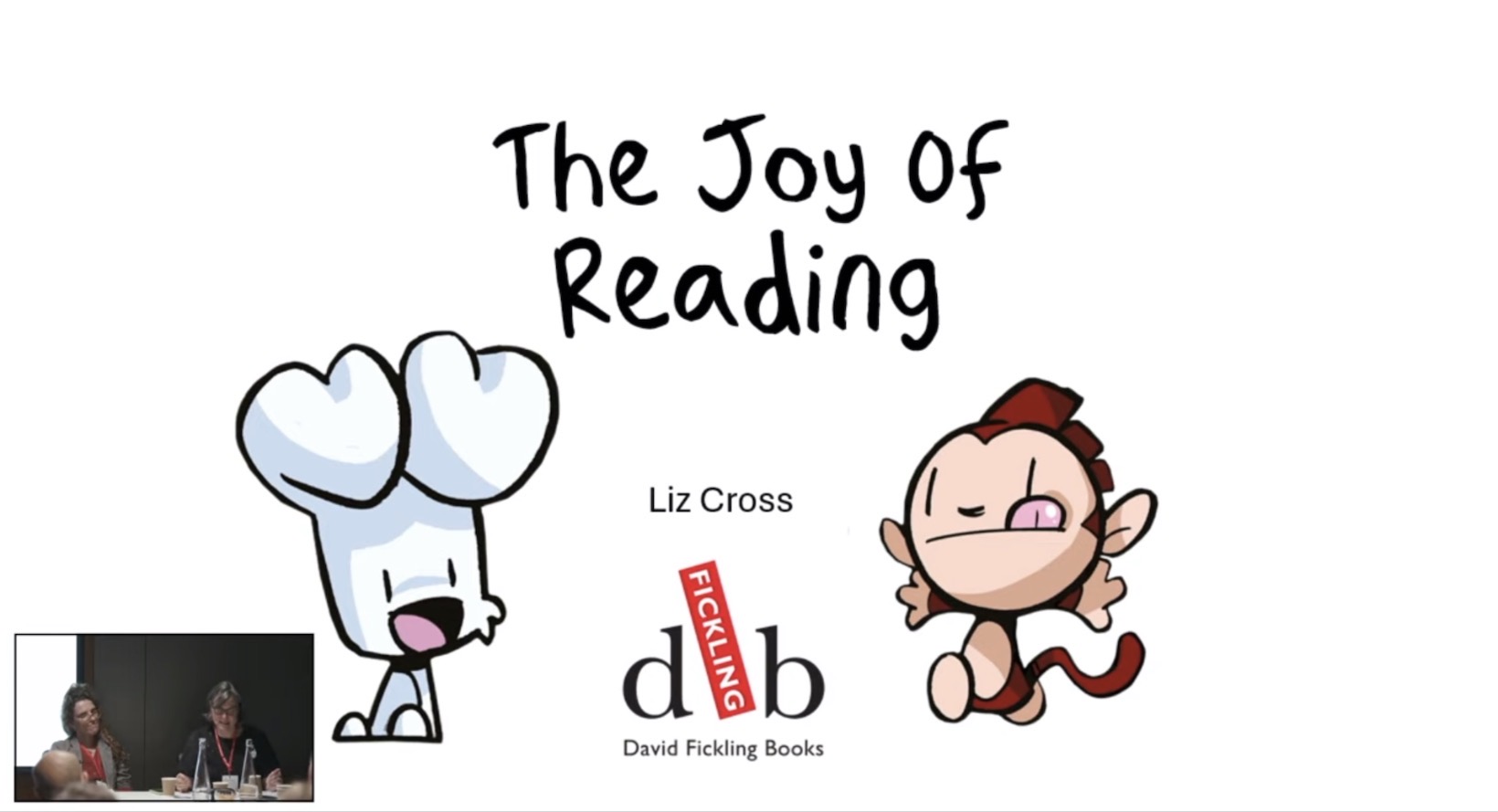
In Cross’s keynote, “The Joy of Reading,” she reiterated how reading for pleasure is one of the most significant indicators in a child’s life, showing they will grow to be happier and more successful than their peers who don’t read regularly. (Cross, 2025) Reading promotes essential values in children, such as empathy, self-confidence, and imagination, along with other literacy skills that support their in-school learning. (The Reading Agency, 2024.) She emphasised how “fun is the unlocker for children engaging with reading” and compared children reading it to playing with LEGO. (World Book Day, 2025) There are many reasons why LEGO is beneficial for a child’s development; however, as adults, we don’t discuss playing with LEGO in overly elaborate terms, like “pleasure”. We simply think of it as something fun that we know children will enjoy, and we let them build and play however they want to. (Cross, 2025)
Cross believes that the publishing industry should approach reading similarly, changing the language used to describe reading statistics and focusing on making reading fun for all ages. For children, reading is primarily an experience-based activity. They enjoy the social aspects of reading because doing it quietly on their own can be boring. Having to do it quietly, like they would homework, leads to it becoming something imposed on them rather than a fun activity they engage with because it brings them happiness. (Patel, 2023)
The use of libraries and reading in classrooms with peers has become increasingly important for literary engagement. It gives children an opportunity to get excited about their own reading experience by chiming in and sharing mutual interests with other children.
Louie Stowell’s campaign “LOKIFESTO” –introduced during Cross’s presentation– aims to highlight the importance of agency and choice in reading. When children read whatever they choose to, they enjoy it and want to do it more. Stowell encourages children to read what they like and not to read what they don’t enjoy, prioritising fun.
“If you redefine what reading is, maybe there isn’t a reading crisis” – Debbie Hicks, Founder of The Reading Agency (Brown, 2025).
There are many ways to read today, from picture books to social media posts, people are reading everywhere, even when it’s not books. Cross gave a couple of anecdotes from her own children and how they read for pleasure in their free time without realising it. They read Wikipedia articles, game descriptions, comics, and other things that would traditionally not be considered reading.
If we expand the definition of reading, we will find that people are reading for pleasure, just not in the ways we expect them to. When we stop looking at reading from a traditional standpoint, we can come to realise that reading for pleasure is not declining. Instead, it is adapting to each person’s individual life. Having the choice to read however and whenever you like makes reading fun and engaging, challenging the statistics that claim a decline in interest.
Bibliography
Brown, L. (2025) ‘The Reading Agency founder urges the trade to reconsider what reading looks like’, The Bookseller, 5 September. Available at: https://www.thebookseller.com/trade-interviews/the-reading-agency-founder-urges-the-trade-to-reconsider-what-reading-looks-like#:~:text=To%20tackle%20a%20%E2%80%9Creading%20crisis,reading%20crisis%2C%E2%80%9D%20she%20posits.
Clark, C., Picton, I. and Cole, A. (2025) Children and young people’s reading in 2025. rep. National Literacy Trust, pp. 1–5. Available at: https://nlt.hacdn.org/media/documents/Children_and_young_peoples_reading_in_2025_bqtGfIs.pdf.
Cross, L. (2025) ‘The Joy of reading’, The Shaw Theatre. IPG 2025 Autumn Conference, London, 16 September.
Green, E. and Braithwaite, A. (2023) ‘Project Matilda: the child’s perspective on motivations and barriers to reading for pleasure’. World Book Day and Beano Brain. https://www.worldbookday.com/wp-content/uploads/2025/08/Beano-Brain-x-World-Book-Day-Project-Matilda-Debrief.pdf
Patel, A. (2023) ‘Why independent reading has to be a social experience’, CLPE: Centre for Literacy in Primary Education, 9 November. Available at: https://clpe.org.uk/blog/why-independent-reading-has-be-social-experience.
The Reading Agency, Arts Council England and Inspire: Culture, Learning and Libraries (2024) ‘Is reading creative?’ Evaluating reader responses to Inspire’s ‘I Am A Reader’ project. rep. TRA, pp. 14–18. Available at: https://readingagency.org.uk/wp-content/uploads/2024/08/TRA-for-Inspire_I-Am-A-Reader-Evaluation-Report_final.pdf.
World Book Day (2023) Our approach and the evidence behind it, World Book Day. Available at: https://www.worldbookday.com/about-us/our-approach/.
 MSc Publishing – Industry Accredited Postgraduate Degree