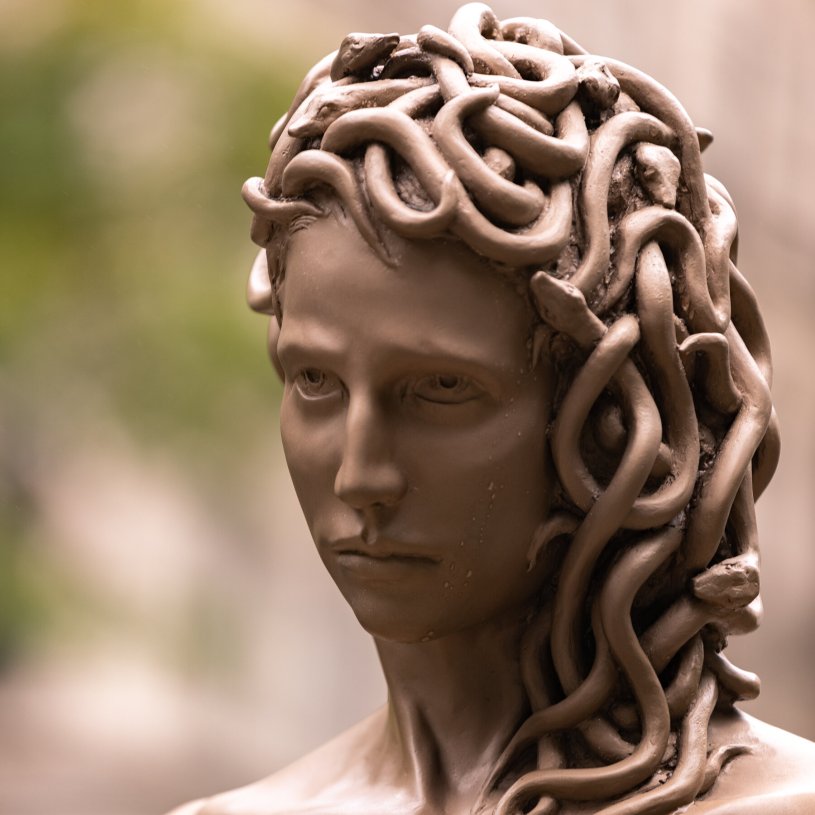
According to its website, the Edinburgh Women’s Fiction Festival “celebrat[es] writing for, by, and about women” – all women. Be it gorgons, sorceresses, goddesses or princesses, the authors at this year’s festival are setting out to change the perception of ‘difficult’ women in history. Rosie Hewlett, author of Greek mythology retellings Medusa and Medea, believes that “villains aren’t born – they’re made” (2025), and this treatment can appear to be reserved solely for female characters. Think of the villain in your favourite fairytale, the evil stepmothers, the wicked queens, the ugly stepsisters. Who was it that was telling us these women were villains? Yes, that’s right – men.

During the panel ‘Goddesses and Gorgons: Rediscovering magic and witchcraft in Greek mythology’, Hewlett and fellow author Phoenicia Rogerson discussed the trope of the “vilified woman” who, throughout history, has not been given a voice to defend herself (2025). Hewlett was fascinated by the figure of Medusa, someone who was “demonised for a man’s crimes”, which the author believes “speaks to the fundamental female experience” (2025). As such, her debut novel, told in Medusa’s own words, brings readers into the mind of a mistreated, misrepresented, and (understandably) vengeful woman, “who has been silenced and shaped by men into something she never wanted to be” (Publishers Weekly, 2021).
The subject of Rogerson’s book is Aphrodite, enigmatic Goddess of Love, who similarly exists in a world of “twisted morality”, where there aren’t really any good guys (or girls) to be found (2025). That said, she believes the secret to writing an interesting, full-bodied character lies in the balance; we must see the sides of someone, the three-dimensionality of what it is to be human and to stray from perfection. For Hewlett and Rogerson, “morally grey characters” are the most intriguing (2025).

Mythological and classical retellings have long occupied a significant space in the market, from Rick Riordan’s YA series Percy Jackson to Madeleine Miller’s The Song of Achilles. Jean Menzies, author of The Lady of the Lake, is aware that “retelling is a buzz word, a marketing word…words to indicate to people what they’re picking up” (2025). Yet, these authors see themselves as maintaining the tradition within which their stories originated, the long-standing belief that “every time someone recounts a myth…it is transformed into something fresh” (Smith 2023). Mythology occupies a unique space in that it is a ”genre that allows for stories to evolve and adapt” (Hewlett 2025); making it an extremely commercially viable undertaking for publishers. There is a huge audience for such retellings, and it seems the opportunities for inventions and alternative perspectives are endless.
“I always think of my novels as being like this: the women’s lives at the forefront while the better-known action of the classic Greek myth rages on in the background” – Jennifer Smith (2023)

Having read Rogerson’s Aphrodite myself, I don’t see her as a villain at all. I see the complexity and chaos that comes with being beautifully three-dimensional. The surge in feminist retellings reveals a desire for women to let their voices be heard, after centuries of misrepresentation and being put on the sidelines. So, maybe these women aren’t villains after all – maybe they’re just like us, women just trying to get through the day in a patriarchal society.
I mean, haven’t we all wanted to turn a man to stone at some stage?
Bibliography
Edinburgh Women’s Fiction Festival. (2025) ‘About Us.’ [online] Available at https://www.edwomensficfest.co.uk/about-1 (Accessed on 6 Oct 2025).
Hewlett, R. and Rogerson, P. (2025). “Goddesses and Gorgons: Rediscovering magic and witchcraft in Greek mythology”, Edinburgh Women’s Fiction Festival (26 September 2025, Edinburgh).
Menzies, J. and Leighton, G. (2025) “Spindles and Swords: Reimagining leading ladies in legends and fairytales”, Edinburgh Women’s Fiction Festival (27 September 2025, Edinburgh).
Medusa (2021). Publishers Weekly. Available at https://www.publishersweekly.com/9781800420663 (Accessed 3 October 2025).
Smith, J. (2023) ‘Jennifer Smith on Greek Myth Retellings’, The Novelry. Available at: https://www.thenovelry.com/blog/greek-myth-retellings#strongmythology-retellings-re-imaginings-or-reinterpretationsstrong, (Accessed 3 October 2025).
Images
Cover image: Luciano Garbati, “Medusa With the Head of Perseus”. Photo credit: Jeenah Moon, The New York Times. Taken from: https://www.nytimes.com/2020/10/13/arts/design/medusa-statue-manhattan.html
Image 1: Edinburgh Women’s Fiction Festival logo. Taken from: https://www.edwomensficfest.co.uk/
Image 2: Botticelli, “The Birth of Venus”, Wikimedia Commons. Taken from: https://plaidonline.com/inspire-and-create/article/celebrating-aphrodite-in-art-for-goddess-of-fertility-day?srsltid=AfmBOooDqs2wEgqAvHJ2gku2FFnb6F7kRzxrD5OInYH7XTNNa9_OGMOZ
Image 3: Sally Mathews. Taken 26th September 2025.
 MSc Publishing – Industry Accredited Postgraduate Degree