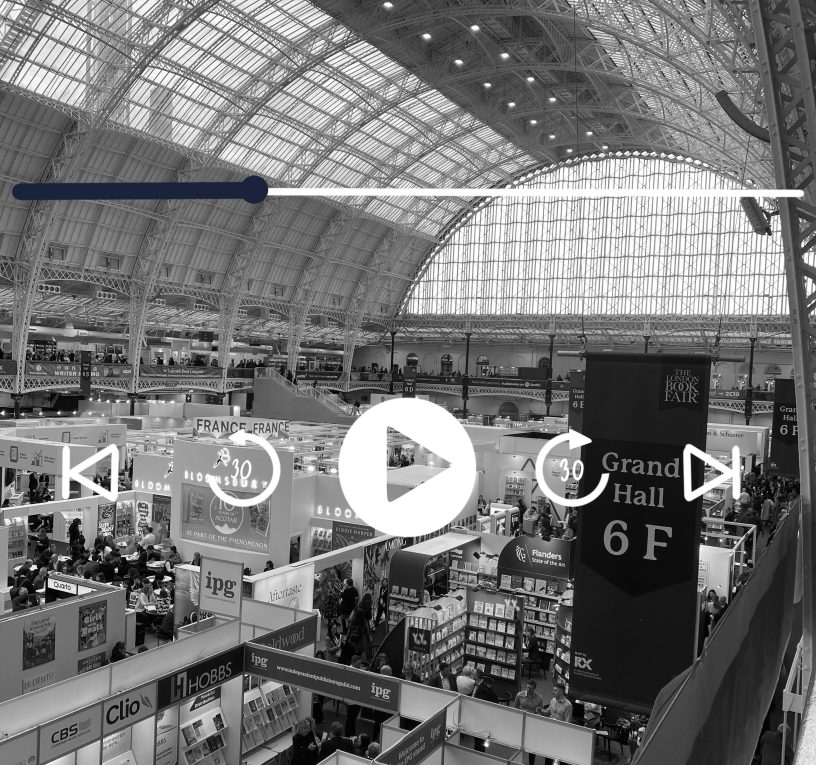
About two months ago, I was fortunate enough to attend this year’s London Book Fair. It was an overwhelming, exciting yet exhausting experience. We had been warned that LBF would be an incredibly busy time for publishing professionals, and with representatives from every corner of the industry present, it certainly showed. As a publishing student, it was therefore quite easy to feel out of place walking around between all the stalls.
However, when publishing professionals were busy with meetings, LBF offered an abundance of panels and discussions – over 10 of which were about audiobooks. I made sure to attend four of them:
Spotify: Expanding the Audiobook Market
Audio Boom: Expanding the Audio Category
Strategies on Audiobook Production and Distribution
What struck me the most about these panels was the tangible excitement and passion about the advancement of audiobooks, both in terms of market and format. Videl Bar-Kar, Vice President Audio for BookWire, noted that while audiobooks were a very niche topic at events like LBF a decade ago, the numerous panels in 2025 reflected the increased interest from both consumers and publishers [1]. The Audio Boom: Expanding the Audio Category panel explored how the stigma surrounding audiobooks as a legitimate form of reading is being dismantled and the exciting opportunities available with audio as a growth-market, emphasising that ‘the time is now’ [4]. Duncan Bruce, Director for Audiobook Partnerships and Licensing at Spotify, outlined what a fantastic year they have had as new entrants in the market, seeming to have capitalised on these opportunities [2]. The Strategies on Audiobook Production and Distribution panel also highlighted that last year saw audiobooks sales surpassing e-book sales in the US market, even though only about 10% of titles available in e-book format are available as audiobooks [1].
Moreover, Georgina Cutler-Ross, Audio Sales Director at Hachette UK, shared that ‘one of the things I love about working with audiobooks is that it’s such a kind of fast moving, increasingly evolving format’ [3]. This evolving format, where the traditional single-narrator approach has been supplemented with multi-cast productions, sound effects, and immersive audio design, reflects the growing ambition and creativity in audiobook storytelling. However, despite the excitement surrounding these new formats and how they might be a gateway format for new readers, several panels made it clear that these are not appropriate for every book. For example, the Transforming Audio panel emphasised the intimacy of a single-narrator approach over ‘bigger, noisier’ formats and the Strategies on Audiobook Production and Distribution panel emphasised the need for investment in technology necessary to produce complex audio dramas. Moreover, both panels highlighted the large costs involved in their production, necessitating an economic assessment with regards to the feasibility of a return on investment [1,3].
Ultimately, it was a delight to attend London Book Fair and get the chance to listen to experts sharing their excitement over the advancement of audio, as well as potential pitfalls. I can only look forward to what we will see next from the audiobook industry.
Bibliography:
[1] Bar-Kar, V., Celaya, J. and Jones, R. (2025). The London Book Fair. ‘Strategies on Audiobook Production and Distribution’. London, 12th of March.
[2] Bruce, D., Lennon, R. and Halstead, S. (2025). The London Book Fair. ‘Spotify: Expanding the Audiobook Market’. London, 12th of March.
[3] Cudden, A., de Troyer, A., Cutler-Ross, G. and Mak, F. (2025). The London Book Fair. ‘Transforming Audio Content’. London, 12th of March.
[4] D’Acierno, A., Frostrup, M., Ghiazza, R. and Restivo-Alessi, C. (2025). The London Book Fair. ‘Audio Boom: Expanding the Audio Category’. London, 11th of March.
 MSc Publishing – Industry Accredited Postgraduate Degree