I always liked helping people achieve their goals, working behind the scenes and assisting someone in their job have been appealing to me. After all, I studied to become a translator, a job known for helping writers and people to be understood in other parts of this big world.
I have a lot of theoretical experience in doing this: the Italian school system prepares you to know how to do research, how to explain complex concepts in a straightforward way for others to understand and especially how to talk properly about the topics that you know. We get an overwhelming amount of information in our heads and a lot of tools on how to use this information, but we have little to no opportunity to apply all this knowledge in a more practical setting. Placements, in the Italian university system, are a situation in which normal students will find themselves seldom. When I saw that the Publishing MSc had a placement module in its program, I was extremely excited about it; I thought that this was an opportunity for me to finally put into practice all the knowledge that I accumulated during my undergraduate studies. I wanted to do something practical, that gave me the opportunity to look at what the work behind the scenes is like, so when in the placement post for The Journal of Scottish Yarns, or Yarn in short, I read about the opportunity to work and attend a photo shoot and learn the process of how to take photos for a magazine, I knew that I wanted to try it, therefore I seized the opportunity and applied for it. I was lucky enough to be chosen by Susan, the publishing editor of Yarn, and that is how I found myself in a photographic studio on a cloudy Sunday in March.
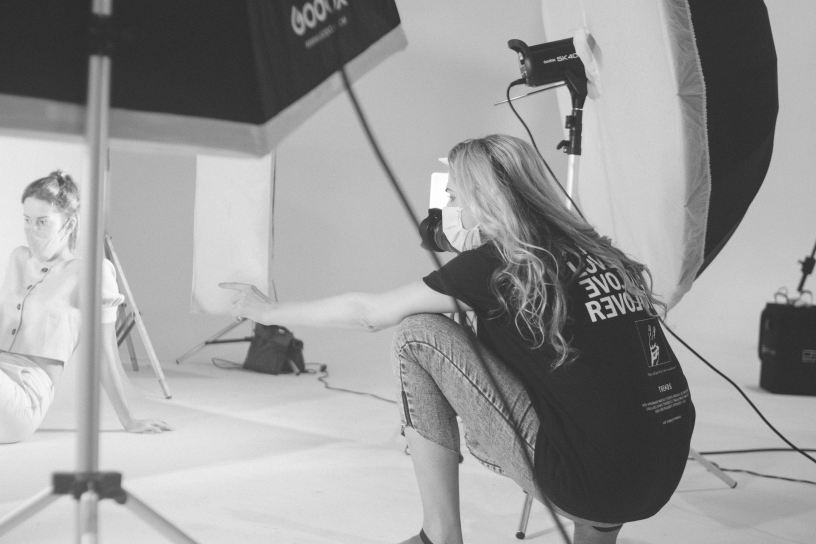
The environment was bubbly and hectic, what I would call organized chaos: models, photographers, assistants, publishing editor and art director, make-up and hair, everyone was excited and ready to start the day. The issue we were taking photos for was the spring/summer one, therefore the dressing choice was focused on flowy and light materials like linen and each knitted garment, the main focus of the magazine, was bright and multicoloured.
In the beginning, I felt like a fish out of water, I did not know what I should have done. I was not sure if I was supposed to just watch and take notes or to actively help anyone who needed assistance. However, my doubts were quickly assuaged by Susan, she pointed me out to Nicky, the graphic designer and art director, saying that I could help her (Nicky) with anything she needed. She gave me a role: I had to help one of the photographers with the flatly of the garments, these kinds of photos are taken from the top down, directly above the arranged outfit, so that the reader could see all the stitches in the patterns of the clothes and the overall finish product that they could achieve by following the schemes that appear inside each issue.
I had a list of all the garments we needed to take photos of, my job was to make sure that there were enough pictures of all the clothes, to arrange them on the background in a simple way that showed off the stitches and the shape of each pattern. I felt useful and like a real member of that team, while doing my assignment I could observe the other tasks happening around me and how everything else was working out, I was even able to give both Susan and Nicky my input, which they accepted gladly. The photographer and I worked together efficiently and quickly, in perfect symbiosis with Nicky and Susan that were organising the photos of the models wearing the different clothes; it was a stimulating environment, creative and inspired, I almost felt at home. It was exactly what I could not find during my university years in Italy, a means to put into practice what I learned, to test my ability on the field and to help someone else in their work; I could finally express my creative side.
After the day wrapped up, I still had more to do, I was given another task: to select between 10 to 15 of the best photos of each garment so that during the final stage of the layout Nicky would have just a small assortment of pictures instead of the thousands and thousands that were taken that day.
Now, looking at the definitive version of the journal ready to go to the printer, I feel a sense of accomplishment, I helped in achieving this amazing result, and I know that the work I did was useful to someone. I am eager to know what my future in this industry will reserve me.
 MSc Publishing – Industry Accredited Postgraduate Degree