
Publishing places authors in the spotlight. But what if we changed the focus? Who would emerge from behind the curtains? At the 2026 London Book Fair, I had an insight into some of the great work that comes from those who do not feature on the front cover.
At the PublisHer Panel, the Invisible work behind access took centre stage. The emphasis was on how the published book could not be produced without the layers of infrastructure in place, and how much of this unseen labour is done by women, who may not be getting the deserved recognition. Whether it is working to make books accessible to communities, translating minority languages into English, which according to founding editor of Istros Books Susan Curtis “opens doors”, or making a book discoverable, there is much invisible labour that goes into the creation, publication and accessibility of a title.
Similarly, translation is another demanding, yet almost invisible task, but without it, so many books wouldn’t have ended up in readers’ hands. For that reason, it is quite surprising that a translator’s name being displayed on the front cover is not a given. The panel Getting Out of the Margins discussed the amount of work involved in making yourself visible as a translator, the difficulty of having to advocate for yourself and how to give translators the recognition they deserve.
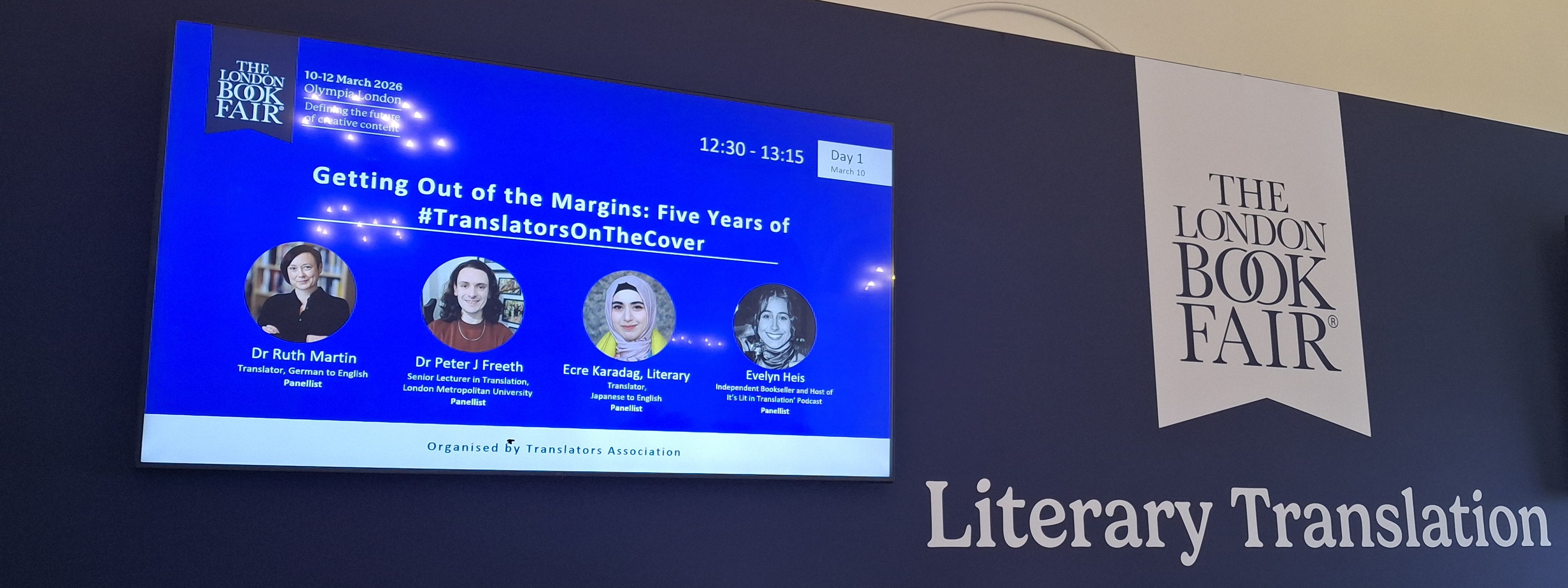
Whilst translators are increasingly being mentioned on the front cover, following the open letter by the Society of Authors in 2021, which asked to name translators on the front cover, there is still more work to be done.
Translators haven’t traditionally been in the spotlight, perhaps because it’s conflicting with Venuti’s idea, which Dr Peter J Freeth (Senior Lecturer in Translation at London Metropolitan University) referred to; a translation is good when you cannot tell it has been translated: in other words, when it’s invisible. This is why, according to Dr Peter J Freeth, translations have typically received more negative press (lost in translation etc), because if something is read as expected, readers don’t worry about the translation.
The speakers agreed that the process of literary translation should be given a spotlight, so that it can be understood, making it easier for people to think critically about translation. Perhaps a greater awareness will help to protect and value translators.
As well as translators not receiving the credit on the front cover, there is also the invisible and unpaid labour of marketing themselves or making themselves visible. It was evident from the conversations, that more support is needed for translators.
Also out of the limelight, is ghost-writing, which can involve writing a whole book, without receiving any credit. The panel Shining the Spotlight on Ghostwriters pointed out that crediting not only allows the ghost-writer to build up a profile, aiding their career, but that there’s also a financial advantage as a name on the title page means eligibility for PLR.
The speakers also insisted on royalty-based contracts, instead of a flat-fee, to help protect the ghost-writer financially.
These London Book Fair seminars were an important reminder that there is so much unseen hard work that goes into the creation of a book. Publishing should continue to strive towards ways, whether financially or through social recognition, to value the invisible work behind the book.
Bibliography
Burton, S., Nadin, J., Bent, L., McCrum, M. and Julien, S. (2026). London Book Fair. Shining the Spotlight on Ghostwriters. [panel]. 10/03/2026. Olympia, London.
Faraz, S., McAveney, M., Curtis, S. and Sells, J. (2026). The PublisHer Panels – The Infrastructure of Reading: The Invisible Work Behind Access. [panel]. 10/03/2026. Olympia, London.
Martin , R., Freeth , P., Karadag, E. and Heis, E. (2026). London Book Fair. Getting Out of the Margins: Five Years of #TranslatorsOnTheCover. [panel]. 10/03/2026. Olympia, London.
Venuti, L. (2017) The translator’s invisibility: a history of translation. London: Routledge.
 MSc Publishing – Industry Accredited Postgraduate Degree