
by Tom Rae
Profile Image Source: Jenny Brown Associates.
“If you’re writing licensed tie-in material, it’s essentially like you’re renting a gorgeous sports car – you have to bring it back intact.” – Bishop, D.V., Edinburgh Literary Salon, 2025.
Writing in the realms of someone else’s intellectual property is not always an easy process to navigate. You inevitably must accept that you are essentially borrowing a character, and obtaining the license to write about said character doesn’t give you creative freedom over the sandbox world you are writing in. As a lifelong fan of Doctor Who, I was excited to hear D.V. Bishop’s comments at the Edinburgh Literary Salon regarding his experience writing his own Doctor Who novels, particularly as they pertained to questions surrounding writing copyrighted characters, and the unique advantages and disadvantages posed for marketing an already-established franchise.
When asked about his Doctor Who books, Bishop was quick to highlight the issues of writing a copyrighted character. “Doctor Who is an example of a character who is officially licensed, and there are people in the BBC whose job it is to stop you from making grievous errors” (Bishop, D., Edinburgh Literary Salon [ELS], 2025). This means that anything you write must avoid drastic alterations to the mythology of the show, or you risk crossing into fanfiction. You are a guest author rather than independent, and the scope of your writing mustbe adjusted accordingly.
Bishop also gave valuable advice about inherent qualities of writing for copyrighted properties: “Your challenge is to write in the spirit of the show. Then […] to do something which has never been done before”, which, considering the history of Doctor Who, could prove difficult (Bishop, D.V., ELS, 2025). This adoption of the “spirit” of the show was interesting because sometimes it can be hard to quantify how to create that sense of adventure or escapism. I was also interested that a publisher might commission a specific type of story: “I was asked ‘would you like to write a Doctor Who audio drama’ […] they said it has to be the Daleks” (Bishop, D.V., ELS, 2025). This encourages writers to think about marketable symbols or characters; this will appeal to franchise book publishers.
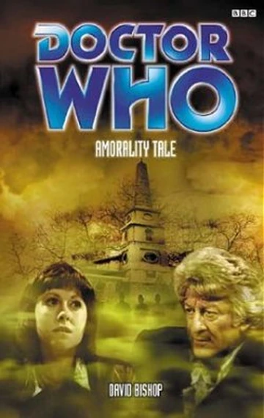
Source: BBC Books, 2002.
It was fascinating to examine the marketing of franchise tie-in novels: would they only be marketed towards a fanbase? Bishop noted that guest authors with their own fanbase, such as Neil Gaiman, may “bring enough of their following” for the publisher to target beyond just “hardened Who fans”, but maintained that the target market is generally “the existing enthusiastic base” (Bishop, 2025). However, a limited market doesn’t necessarily translate to lower sales; Anthony DePetrillo credited the “overwhelming” response towards the reissuing of Target novelisations in 2012 with the imprint’s expansion of their Doctor Who range (Cowdrey, K., 2016). Furthermore, franchise books naturally garner attention from putting their logo on the book cover, so there is less requirement to build brand characteristics than there would be for an author’s original work.
As someone who has interacted with Who content as a consumer for my whole life, it was brilliant to hear Bishop discuss the behind-the-scenes of franchise publishing, especially since it opened my eyes to an area of publishing I may consider for my future career.
Bibliography
Primary Sources
Bishop, D. 2025, Edinburgh Literary Salon.
Bishop, D., Rae, T. 2025, “Interview with D.V. Bishop”, Edinburgh Napier University, Unpublished Interview.
Secondary Sources
Cowdrey, K. 2016, “BBC Books reissues seven Doctor Who Classics”, The Bookseller, Available at: https://www.thebookseller.com/news/bbc-books-reissue-seven-doctor-who-classics-target-books-321308 [accessed 15/10/2025].
 MSc Publishing – Industry Accredited Postgraduate Degree