
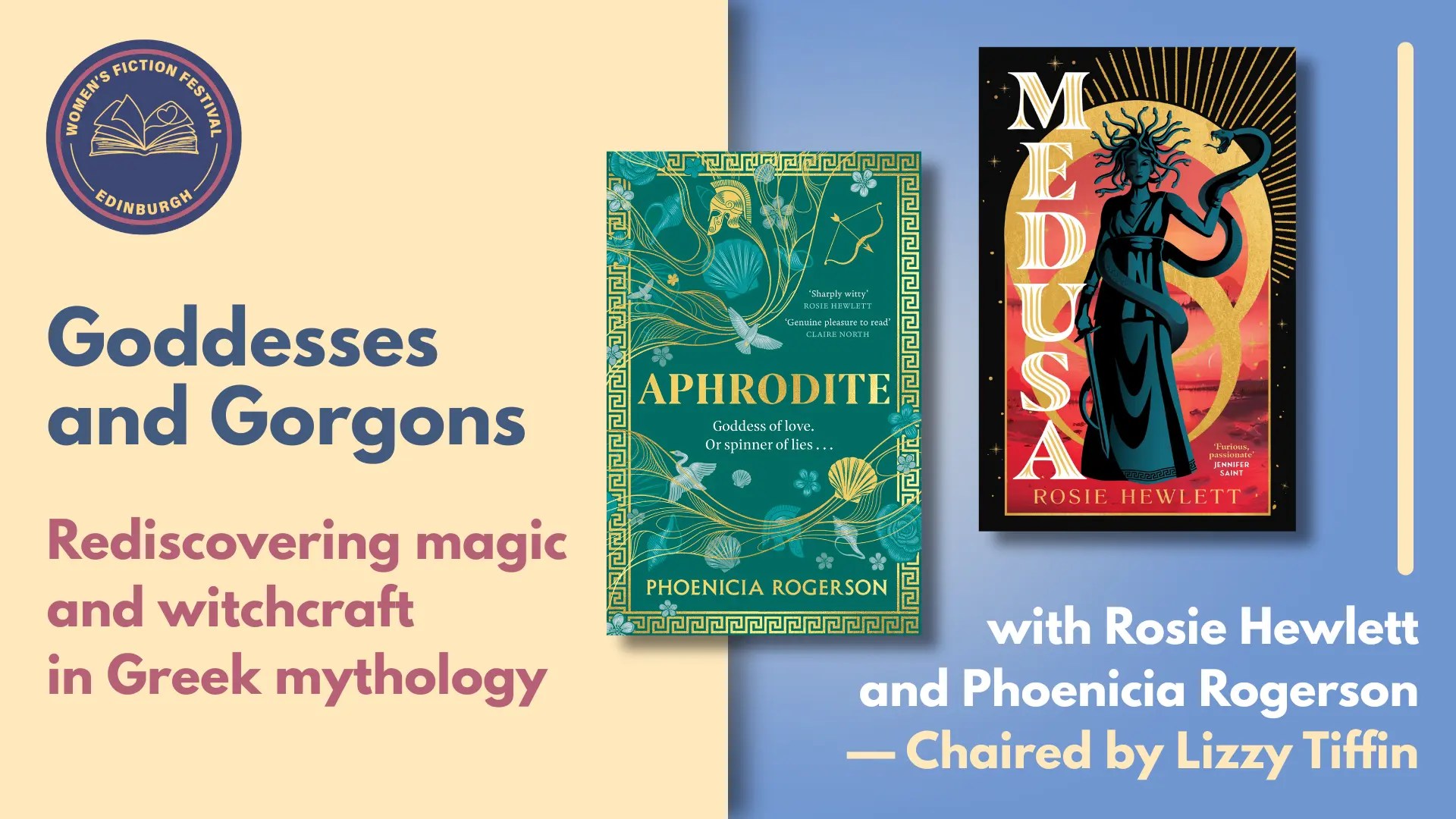
Image Credit: https://www.crowdcast.io/@edwomensficfest
The Edinburgh Women’s Fiction Festival is all about celebrating women’s writing, about and by women, so it was fitting that its September programme kicked off with “Goddesses and Gorgons: Rediscovering magic and witchcraft in Greek mythology”. Led by Lizzie Tiffin, the session included debut novelists Rosie Hewlett (Medusa) and Phoenicia Rogerson (Aphrodite) talking about why they had set out to re-tell the stories of two women turned monster in classical literature.
Hewlett first had the general assumption that Medusa was a “gorgon with snake hair” who petrified men. She later learned Medusa was human and “blamed for a man’s faults”. Writing her book was “cathartic and empowering” now because it gave Medusa voice. Rogerson is less concerned about sanitizing the goddess of love. Her Aphrodite is bad and “does a lot of really terrible things,” but Rogerson resisted the gods existed in a parallel moral universe: “there really aren’t good guys.” By establishing the motives of her heroine, she instructs readers no one enters the world with an evil heart, both authors in agreement that morally complex women are infinitely more interesting than the overwritten ideal heroine.
The panellists also touched on the wider issue of why feminist reinterpretations are so fashionable at the moment. Rogerson joked that the generation that grew up on Disney’s Hercules finally have “money to spend” on Greek myths. In a more serious note, she references the fact that women were barred from studying classics for centuries and finally have attained a large enough “critical mass” to reclaim them. Hewlett continued to explain that men wrote such plays as Medea and performed them before men; women nowadays are “filling in … seeing these myths from a woman’s point of view.”. This is an emerging publishing trend: Guardian writer Sarah Shaffi states that readers are still enthralled with re-tellings because readers are starved of stories that present a different take on modern life and femininity politics (Shaffi, 2023).
These re-tellings are highly feminist in tone. The Bubble’s Abby Donaldson observes reinterpretations such as those by Natalie Haynes, Madeline Miller and Jennifer Saint prioritize under-represented women and prove that greek epics can give focus to women’s experiences without losing tension (Donaldson, 2022). Writer Jennifer Saint reminds us that a foundational trait of myth is how they change through oral retellings and that their eternal appeal comes in common themes of love and loss (Saint, 2023). Mathews speaking on the business aspect, points to how retellings are lucrative as they provide “endless opportunities for invention and alternative views” (Mathews, 2025).
Overall, Hewlett and Rogerson are doing more than just reimagining these renowned but stigmatised characters, the reasserting of their multifaceted nature is a form liberation and cultural activism. Their novels ask us to think about who have voices and who have lost them and how myths we’ve learned to comprehend shape our understandings of gender and power. This panel was hugely enlightnening for me in coming to understand how important it is to continue to push for more representation from marginalised groups, as its their narratives that push the industry forwards with so many interesting point of views and cultures that have yet to have the time or resources to share their stories.
Bibliography:
Donaldson, A. (2022) ‘Fastening the tunic: feminist retellings of Greek mythology’. The Bubble. 18 November 2022. Available at: https://www.thebubble.org.uk/culture/literature/fastening-the-tunic-feminist-retellings-of-greek-mythology/ (Accessed: 15 October 2025)
Edinburgh Women’s Fiction Festival (2025) ‘Goddesses and Gorgons: Rediscovering magic and witchcraft in Greek mythology’ panel discussion. 26 September 2025, Edinburgh.
Mathews, S. (2025) ‘Supporting women’s rights and women’s wrongs – how feminist retellings are championing female “villains”’. MSc Publishing blog, 9 October 2025. Available at: https://publishingdegree.co.uk/2025/10/09/supporting-womens-rights-and-womens-wrongs-how-feminist-retellings-are-championing-female-villains/ (Accessed: 15 October 2025)
Saint, J. (2023) ‘Jennifer Saint on Greek Myth Retellings’. The Novelry, 18 June 2023. Available at: https://www.thenovelry.com/blog/greek-myth-retellings (Accessed: 15 October 2025)
Shaffi, S. (2023) ‘Two sides to a story: why feminist retellings are filling our bookshelves’. The Guardian, 24 March 2023. Available at: https://www.theguardian.com/books/2023/mar/24/two-sides-to-a-story-why-feminist-retellings-are-filling-our-bookshelves (Accessed: 15 October 2025)
 MSc Publishing – Industry Accredited Postgraduate Degree