
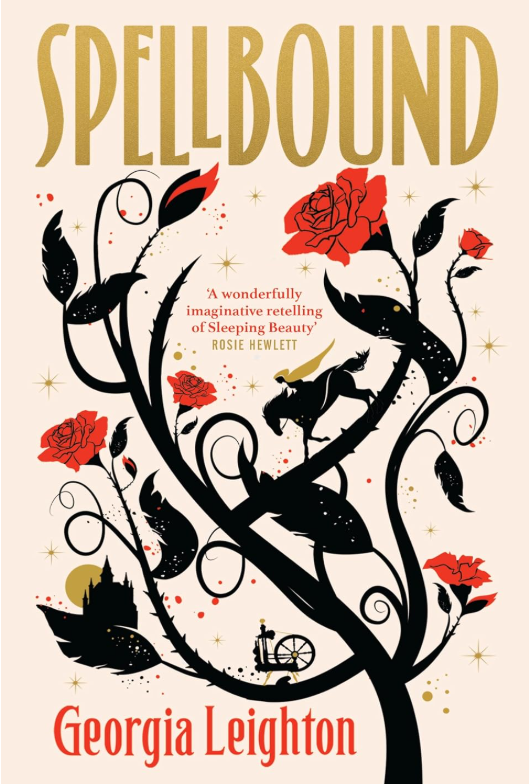
Stepping into Edinburgh’s festival scene three years ago, the Women’s Fiction Festival has established itself through its joyful celebration of women’s fiction. At this year’s festival, I had the privilege of a front row seat to how women’s voices are being put to the forefront in fiction. Amongst romances and revived classics, it was the fairytale retellings in Spindles and Swords which captured my attention. Georgia Leighton’s novel Spellbound, a Sleeping Beauty retelling, sparked discussion on how fairytale retellings enrich female representations.
For many of us, our first encounter with fairytales was through Disney movies: Snow White, Sleeping Beauty, Cinderella. These were stories I sat in front of the TV to watch on repeat. Their influence over popular culture is undeniable as Melanie Goldman attests in The Rise of Fairytale Retellings in Publishing, authors who write retellings “almost always say they were inspired by a Disney movie”(2023, p.221). Yet Disney’s female characters are idealised and one-dimensional. At the festival, Georgia Leighton reflected on how she used Spellbound to challenge the Disney retellings she grew up watching. Georgia commented, I could “interrogate what I was massively brainwashed into thinking […] that my appearance was paramount to my kind of worth in the world” (2025). Georgia’s fairytale retelling is thus her way to give female characters back their voices. This resonated with readers, illustrated by Spellbound’s success as a Sunday Times bestseller (Penguin Random House, 2025).
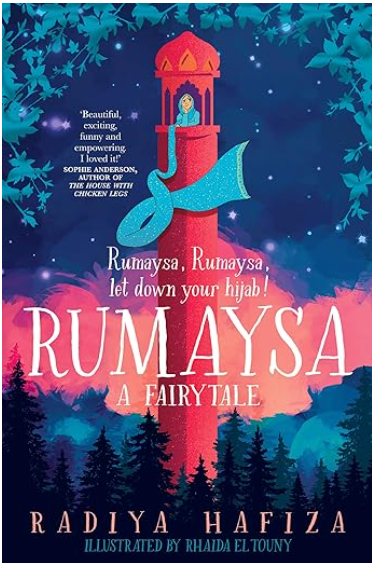
Yet Spellbound is only the latest fairytale retelling in a line of successful books in the market. Among these include books from Marissa Meyer and Brigid Kemmerer. In Meyer’s novel Cinder (2012), her heroine is a cyborg with prosthetics, representing a disabled character. The novel’s enduring popularity is illustrated by the new hardcover collector’s edition released in 2022 (Meyer, 2022). Another example is Kemmerer’s goodreads nominated Cursebreaker series (2019-21) whose protagonist Rhen has cerebral palsy. These novels exemplify how recent fairytale retellings work to subvert Disney’s ubiquitous yet limited female representations. Children’s fiction is also joining the trend. For example, Rumyaysa: A Fairytale (2023): a children’s book which recasts Rapunzel as a Muslim girl whose hijab rather than hair scales her tower. From this eclectic but not exhaustive list, we see how recent fairytale retellings have spawned a myriad of diverse representations.

However, literary retellings come with controversy. Michaela Makusha worries this trend does not leave much space for original storytelling. She wonders if publishers should be investing in “the classics of the future, as opposed to churning out the same settings and plots” (2022). Yet this does a disservice to what fairytale retellings offer to the market. While these retellings may have similar settings and plots, it is the perspectives which differ. In an industry struggling to reach more diverse audiences (Saha and Lente, 2020, p.2), retellings allow publishers to bank on widely known narrative templates to champion diverse voices.
Fairytale retellings are not just the same old stories catering to reader nostalgia. When it comes to retellings such as Disney’s it is not the stories that are tired but the perspectives. Fairytale retellings bridge the gap between the stories readers cherish and the new context within which they live. As our society continues to change, new experiences emerge, endlessly reinventing the fairytale formula.
Bibliography
Goldman, M. 2023. The Rise of Fairytale Retellings in Publishing. Publishing research quarterly, 39 (3) September, pp. 219 – 233.
Leighton, G. 2025. Spellbound. London: Transworld.
Makusha, M. 2023. Same Old Stories. [Online] Available at: https://www.thebookseller.com/comment/same-old-stories [Accessed 21 September 2025].
Meyer, M. 2022. Celebrating a Decade of Cinder!. [Online] Available at: https://www.marissameyer.com/cinder/celebrating-a-decade-of-cinder/ [Accessed 2 October 2025].
Meyer, M. 2012. Cinder. London: Puffin.
Penguin Random House. 2025. About Georgia Leighton. [Online] Available at: https://www.penguin.co.uk/authors/302827/georgia-leighton [Accessed 9 October].
Saha, A and Lente, S.V. 2020. Rethinking ‘Diversity’ in Publishing. [Online] Available at: https://www.spreadtheword.org.uk/wp-content/uploads/2020/06/Rethinking_diversity_in-publishing_WEB.pdf [Accessed 4 October].
Women’s fiction festival Edinburgh. 2025. Spindles & Swords: Reimagining leading ladies in legends and fairytales with Georgia Leighton & Jean Menzies — Chaired by Amanda Block. Edinburgh. 27 September.
Images
Feiwel & Friends. 2022. Cinder Collector’s Edition: Book One of the Lunar Chronicles. Book cover. [Online] Available at: https://www.amazon.co.uk/Cinder-Collectors-Book-Lunar-Chronicles/dp/1250851033 [Accessed 6 October 2025].
Penguin Random House. 2025. Spellbound. Book cover. [Online] Available at: https://www.penguin.co.uk/books/460890/spellbound-by-leighton-georgia/9781804993989 [Accessed 29 Spetember 2025].
Touny El, R. 2023. Rumaysa: A Fairytale. Book cover.
 MSc Publishing – Industry Accredited Postgraduate Degree