“Achilles’ wrath, to Greece the direful spring
Of woes unnumber’d, heavenly goddess, sing!”
~ Homer, The Iliad (trans. Alexander Pope, Wilco Publishing House, 2025, p. 1-2)
One of the oldest surviving works of literature, Homer sparked a timeless fascination with gods, heroes, and most importantly, the flaws that make them human. Centuries later, we continue to enjoy these stories through retellings.
Why do we enjoy Greek Mythology Retellings so much?
Inspired by my attendance at the “Goddesses and Gorgons” Panel at Edinburgh Women’s Fiction Festival, I was very interested in the topic of Greek Mythology retellings and why they are still so popular today.
Through research, I found that the attraction to Greek Mythology may stem from society’s concern with issues like equality and human rights, themes that are prevalent in many of the original texts about the Gods. (Drobot, 2023). Similar to humans, the gods are portrayed as being imperfect, with Drobot (2023) noting that “they can be jealous, they can cheat, and they can take revenge”. This reflects the humanity hidden behind their godly facades.
According to Knowles (2024), the purpose of retellings is to make classic stories relevant to modern readers, exploring them through new angles and perspectives. Arguably, I believe that these stories have always been relevant to readers; they have now simply been translated into a format that captivates us.
The Edinburgh Women’s Fiction Festival

Over the past couple of decades, female authors have served as a voice for the “marginalised female characters from ancient stories whose characterizations were deprioritized over their male counterparts” [SIC], (Bretzinger, 2023), giving readers a newfound appreciation for these ancient stories. This can be seen in books like Madeline Miller’s Circe, Claire North’s Ithaca, and, more notably, Phoenicia Rogerson’s Aphrodite and Rosie Hewlett’s Medusa, two authors I had the privilege of listening to at the “Goddesses and Gorgons” Panel at the Edinburgh Women’s Fiction Festival 2025.
Rosie Hewlett, in particular, tells us that she wrote Medusa because she is such a famous character within Greek Mythology, whose voice is violently absent from the narrative. “She doesn’t really speak for herself ever, she’s just portrayed as this mindless monster who turns men to stone”. (Rosie Hewlett, Edinburgh Women’s Fiction Festival, 2025). She wanted to give Medusa a voice to finally set the record straight, and she describes this experience as “cathartic” and “empowering” to finally give her that voice.

The Love for Greek Mythology Retellings
So why do we love Greek Mythology retellings? Is it because they speak to themes close to the heart? Is it to give morally grey characters known throughout history as villains a voice to tell their story? Or is it because whether they are God, hero or villain, their core divinity is stripped down to show us that humanity is at the heart of every story? A reader can be influenced by one or many of these reasons, but what is certain is that Homer, a great poet, gave us the foundation for these stories, and it’s a beautiful thing that their voices are still being heard all these years later.
“These words soft pity in the chief inspire,
Touch’d with the dear remembrance of his sire.”
~ Homer, The Iliad (trans. Alexander Pope, Wilco Publishing House, 2025, p. 621)
Bibliography
Bretzinger, B.R. (2023). Feminist Retellings of Homer’s the Odyssey, 2005-2022 . [online] Available at: https://huskiecommons.lib.niu.edu/cgi/viewcontent.cgi?article=2453&context=studentengagement-honorscapstones [Accessed 7 Oct. 2025].
Drobot, I.A. (2023). Fascination with Ancient Myths Nowadays in Novels. Masters International. International Academic Conference Economics, Business and Contemporary Discussions in Social Science, p.37. [Accessed 6 Oct. 2025]
Homer (2025). The Iliad. Translated by A. Pope. Delhi: Wilco Publishing House. , pp.1–2. (Original Work Published 1715). [Accessed 7 Oct. 2025]
Knowles, Z. (2024). Retellings of 2023: Ancient Mythology Continues to Appeal. The Bookseller. Available at: https://www.thebookseller.com/bestsellers/retellings-of-2023-ancient-mythology-continues-to-appeal. [Accessed 6 Oct. 2025]
Rosie Hewlett, Edinburgh Women’s Fiction Festival (2025) Goddesses and Gorgons. 26th September 2025.Edinburgh. [Attended 26 Sept. 2025]
Images
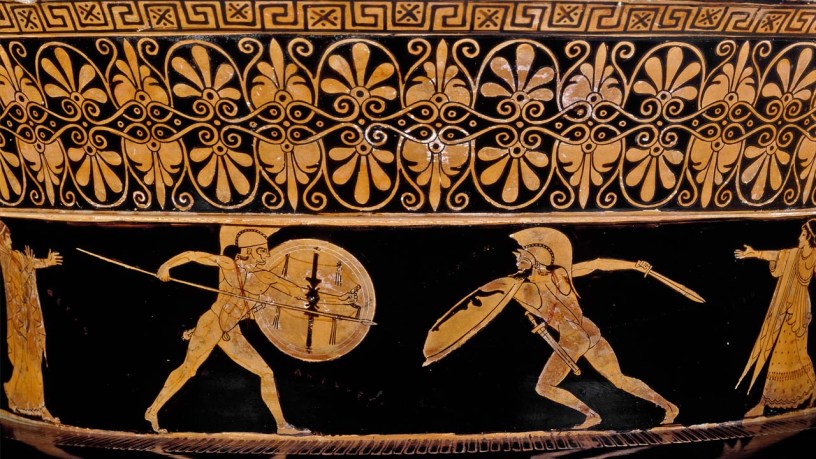
Image 1/ Cover Photo: Achilles fights the Ethiopian King Memnon [Achilles Versus the Ethiopian King Memnon] from a red-figured volute-krater attributed to the Berlin Painter. Greece, about 500-480 BC. © The Trustees of the British Museum. Taken from www.theiliad.com/About
Image 2: Taken from Edinburgh Women’s Fiction Festival Instagram. Instagram handle: edwomensficfest. Date of photo posted: 26th September 2025
Image 3: Taken by Shauna McDonnell. Date taken: 7th October 2025
 MSc Publishing – Industry Accredited Postgraduate Degree