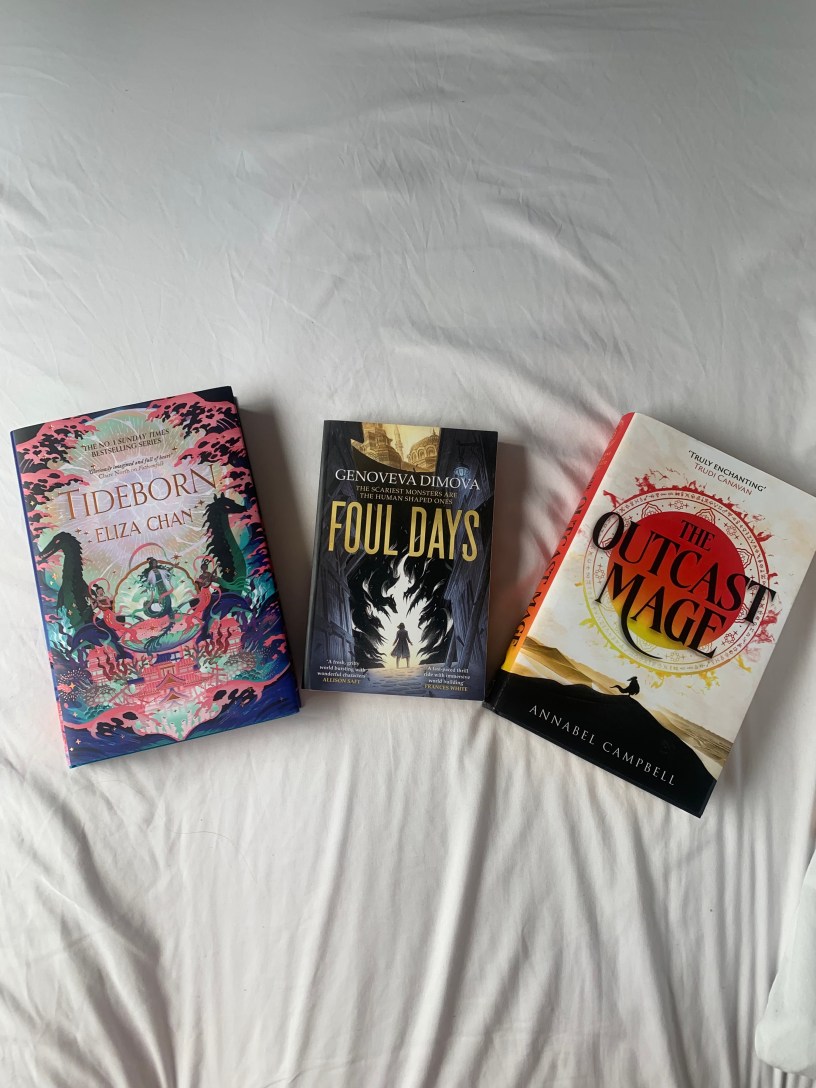
At a discussion panel held at Waterstones, authors Genovena Dimova, Eliza Chan and Annabel Campbell discussed outsiders in fantasy in respect to their novels Monstrous Nights, Tideborn and The Outcast Mage. The main theme of the discussion was around how outsiders are written in fantasy, and the different approaches authors take when writing these characters and the magic systems of fantasy. Characters may be outsiders because of their magic, isolated from society because of fear around what their powers may do. Or they may be isolated because of their lack of magic and seen as inferior to those who have power.
During the discussion, all three of the authors agreed that their inspiration to write was greater when the state of the world felt turbulent, and they felt angry at what was happening. Intentionally or not, they were able to write a world where they address these real world frustrations through the magic systems and outsiders in their fantasy novels – Eliza Chan admitted that she didn’t realise her Drowned World duology had strong political themes until her family and friends read it and pointed it out to her!
After I left the event, I was inspired to reflect on why readers and authors are drawn towards fantasy and stories about outsiders when the politics of the world feel difficult and unjust, and what this means for the wider publishing industry – could publishing houses predict a surge in interest in fantasy when times feel particularly difficult?
The Guardian reported in 2023 that one in three readers found that books offer the best form of escapism when they feel like they had a bad day. It is clear that the fantasy genre in particular offers a form of escapism: readers are able to invest in a world and characters exciting similar struggles that they may be facing but in a setting which is unfamiliar, new and exciting. In other terms, it is a way to process difficult themes but, in a fantasy, setting that offers just enough escapism that it doesn’t weigh down the reader with constant reminders of the real world and what the reader will have to face once they put the book down again.
In terms of the outsider perspective, why are these characters in particular so common in fantasy? In an interview with physiologists on why people are drawn to fantasy, Mae Thornton discussed with Dr. Kevin Brown how readers enjoy seeing how characters can overcome their challenges and give the impression that it is possible to see a future beyond their struggles, showcasing the importance of optimism when dealing with difficult times. Characters which are outcasts are the perfect opportunity to experience this optimism with authors showing their struggles and isolation but often also showing them challenging and overcoming their struggles to provide a better future for themselves and others.
Whatever the reason for the popularity of fantasy during tough times, readers, authors and publishers are all grateful for its presence whenever times feel difficult.
References
Shaffi, S. 2023. One in three say books offer best form of escapism when having a bad day. The Guardian [online]. Available from: https://www.theguardian.com/books/2023/jun/08/one-in-three-say-books-offer-best-form-of-escapism-when-having-a-bad-day [Accessed 11 May 2025].
Thornton, M. 2018. The Psychology of Fantasy. Medium [online]. Available from: https://cosgrrrl.com/the-psychology-of-fantasy-b871f29b3ef5 [Accessed 11 May 2025].
Image credit: Rebecca Cowan
 MSc Publishing – Industry Accredited Postgraduate Degree