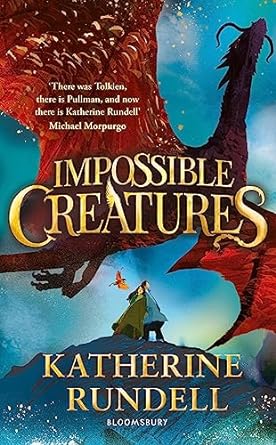
Who remembers the first fantasy series they ever truly became lost in? So lost that returning to reality felt like a real chore, returning to the mundane of everyday life? Katherine Rundell, author of popular children’s fantasy novel Impossible Creatures, knows this feeling all too well. At the 2023 Bookseller’s Children’s Conference, Rundell spoke beautifully on the ‘magic of magic’ and how fostering a love of fantasy in children was not only beneficial for them, but also for the author. Rundell describes her specific style of world-building as ‘threading reality through the impossible.’ In the novel, she has the protagonist walk across a tightrope in a scene that is gripping and puts one’s heart in one’s throat, an experience based entirely on Rundell’s own childhood when she practised trapeze in the circus. By building on real events, Rundell is able to make the mundane seem extraordinary, an aspect of fantasy fiction that remains with the reader long after turning that last page.
Many studies have found that fantasy fosters a strong sense of imagination, creativity and individualism in children. In fact, it has been proven that fantasy can aid in problem solving and basic comprehension of stories in even the youngest of children. In a report titled ‘The Magic School Bus Dilemma’, Hopkins and Lillard state that impossible scenarios such as ‘talking bears cannot exist in reality; however, anthropomorphic characters in children’s media often behave in completely realistic ways and occupy otherwise realistic worlds (e.g., Arthur, The Berenstain Bears)’ (Hopkins and Lillard, 2021) From this, we can gather that popular children’s media tend to use these familiar anthropomorphic creatures encourage learning because children are able to distend their disbelief much more robustly than an adult can. Children want to believe in talking bears, making it easier for them to retain information that the bear is trying to tell them.
Fantasy matters also because it is often a gateway into fostering a love of reading in children. In fact, a study conducted by Renaissance Accelerated Reader found that more children are reading for pleasure now than ever. The What Kids Are Reading Report found that ‘pupils read 27,265,657 books in the 2021-2022 academic year, 24% more than the 2020-2021 academic year.’ (Renaissance, 2023) These encouraging numbers are largely due to the influence of social media such as TikTok in advertising to children about what books they might be interested in, and also advertising to parents about what books they should be buying.
Rundell’s passion for fantasy writing is palpable during her portion of the conference, specifically when she talks about how ‘we were taught these huge truths. We were taught about love and power, faith and care and wit and that seems to me one of the things children’s books do that almost no other form of literature does because they do it with such distillation.’ (Rundell, 2023) Fantasy has the power to transcend age, gender and socioeconomic background as it is, first and foremost, storytelling about what it means to be alive in this great big world.
References
Hopkins, E.J. and Lillard, A.S. (2021) ‘The magic school bus dilemma: How fantasy affects
children’s learning from stories’, Journal of Experimental Child Psychology, 210, p. 105212.
doi:10.1016/j.jecp.2021.105212.
Jarosh, C 2021, ‘What Kids are Reading 2021’, Renaissance Accelerated Reader. Available
at https://www.renlearn.co.uk/renaissance-blog/what-kids-are-reading-2021-the-summary/
Rundell, K 2023, ‘The Magic of Magic: On Writing for Children and the Power of Fantasy’, The Bookseller Children’s Conference 2023, Waterloo: United Kingdom, 2nd October.
 MSc Publishing – Industry Accredited Postgraduate Degree